builderz-labs/mission-control · 25 Jul 2026 · Feature
Agent Orchestration’s Local-First Rebellion Runs on SQLite

Megan Russo
Staff Writer
Builderz Labs built a zero-dependency dashboard for AI agent fleets, betting that operators want governance without cloud lock-in or enterprise bloat.
builderz-labs/mission-control
★6.4k stars
star history
The Hype and the Governance Gap
The current agentic AI boom has generated a profusion of frameworks—CrewAI, LangGraph, AutoGen, Claude SDK, and others—that make it trivial to spin up an agent that can browse the web, call an API, or write a file. What they do not provide is an operational backbone. A 2025 MIT NANDA study, cited in a TrueFoundry analysis of the landscape, reports that 95 percent of generative AI pilots fail to deliver measurable ROI. The culprit is not model quality; it is the absence of production governance, security, and operational controls. Prototyping tools let developers build agents, but they do not enforce access management, audit tool calls, or prevent a runaway loop from burning through a month’s API budget in an afternoon.
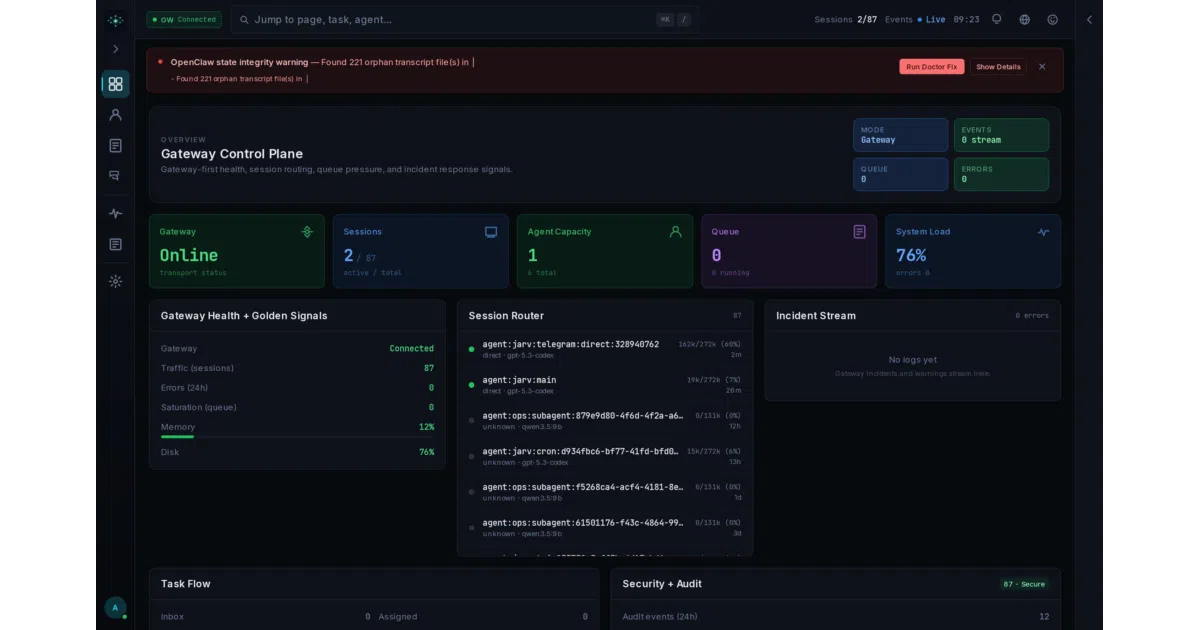
Enterprise vendors have noticed the gap. The market is shifting from chatbots to agentic systems that plan, use tools, and execute multi-step business processes, and buyers are now looking for on-premises platforms that can enforce compliance. Yet the solutions on offer—IBM watsonx Orchestrate, Red Hat OpenShift AI, VDF AI—tend to arrive as Kubernetes-native control planes with the attendant complexity of VPC-native deployment, cluster management, and enterprise pricing. Into this dichotomy steps Mission Control, an open-source project that treats agent orchestration as a local-first web application rather than a distributed systems thesis. Its wager is that most teams need a flight director, not a data center.
What It Actually Is
Mission Control is a Next.js 16 application written in TypeScript 5.7, backed by SQLite in WAL mode and wrapped in a single-page shell. The entire state of an agent fleet—tasks, agents, skills, memory chunks, token logs, security audits—lives in one file on disk. There is no mandatory Redis, no Postgres, no Docker Compose maze to navigate. The project is designed to start with a single command, and a gateway-optional mode lets the dashboard run standalone for project and task management even when firewall rules or air-gapped policies block gateway connections.
Inside the shell, 32 panels cover the full lifecycle of agent operations. A Kanban task board moves work from inbox through assigned, in-progress, review, quality review, and done, with drag-and-drop, priority levels, and inline sub-agent spawning. A memory browser surfaces an interactive knowledge graph linking sessions, memory chunks, and files. A cost-tracking dashboard breaks down token usage by model with trend charts. Real-time updates flow over WebSocket and Server-Sent Events, with smart polling that pauses when the operator steps away. The architectural insight is almost retro: treat the orchestrator as a fast, local web app that happens to manage distributed agents, rather than as a distributed system in its own right.
The project also nods toward operators who are not cron-expression wizards. Its scheduler accepts natural language like “every morning at 9am” or “every 2 hours,” parses the phrase into a cron expression, and stores the schedule in task metadata. A template-clone pattern keeps the original task as a template and spawns dated child tasks on schedule. For teams already embedded in Claude Code or Codex, a read-only bridge surfaces local sessions, team tasks, and configurations on the dashboard without requiring a replatform. It is a pragmatic recognition that most agent workflows today live in terminals and local directories, not in managed cloud sandboxes.
The entire application is a single-page shell routing 32 panels through Next.js App Router, with Zustand handling client-side state. The API surface is 101 REST endpoints documented in an OpenAPI 3.1 spec, browsable through a Scalar UI. This is not a static status page; it is a programmable control plane that happens to ship with a GUI.
The Governance Layer
The project’s most distinctive feature is not the stack, but the operational rigor it layers on top of frameworks that usually ignore such concerns. A four-layer evaluation framework scores task completion against golden datasets, detects convergence loops and infinite traces, measures tool reliability at p50, p95, and p99 latencies, and flags behavioral drift when an agent’s output deviates more than ten percent from a four-week rolling baseline. A built-in Aegis review system can block task completion until a human operator signs off, turning the Kanban board into an actual quality gate rather than a cosmetic status tracker.
Security tooling includes real-time posture scoring on a zero-to-hundred scale, secret detection across agent messages, MCP tool-call auditing, and hook profiles that range from minimal to strict. The Skills Hub, which lets operators browse and install capabilities from external registries, runs a built-in scanner that checks for prompt injection, credential leaks, data exfiltration, obfuscated content, and dangerous shell commands before anything touches the database. Role-based access control splits users into viewers, operators, and admins, and authentication supports both session cookies and API keys for headless access.
Outbound integrations are handled with the same sobriety. The webhook system implements delivery history, retry with exponential backoff, circuit breakers, and HMAC-SHA256 signature verification. GitHub Issues sync supports label and assignee mapping. Agent-to-agent messaging travels over a dedicated comms API. Even multi-tenancy is partially addressed: super-admin endpoints can provision isolated workspaces, each with its own gateway and state directory, though the documentation notes this is still evolving. This is the unglamorous infrastructure that separates a prototype from a production system, and it is exactly the layer that the MIT NANDA study suggests is missing from most AI pilots.
Position in the Landscape
Mission Control does not pretend to be an MLOps platform or a model-serving layer. It is an ops console that normalizes multiple agent frameworks into a single control surface. Built-in adapters translate registration, heartbeats, and task reporting from OpenClaw, CrewAI, LangGraph, AutoGen, and the Claude SDK into a common interface. The project can therefore sit alongside existing agent investments rather than forcing a rewrite.
This places it in an emerging category of self-hosted agent infrastructure that prioritizes data sovereignty over vendor convenience. Ibl.ai, for instance, markets an MIT-licensed OpenClaw runtime that executes entirely inside a customer’s cloud account or air-gapped environment, transmitting only orchestration metadata over an Ed25519-signed WebSocket. The HuggingFace community has also seen projects like AI Agent Host, a Docker-based environment that runs Claude Code alongside QuestDB and Grafana, explicitly excluding middleware frameworks in favor of direct container-to-container communication. Mission Control shares that ethos: keep the runtime close to the data, avoid vendor intermediaries, and let the operator own the stack.
The enterprise alternatives occupy a different tier. TrueFoundry draws a sharp line between “AI agent tools”—narrow frameworks or workflow builders—and “AI agent platforms,” which it defines as environments that uniformly enforce access management, observability, cost governance, and compliance across workloads. By that definition, Mission Control is trying to be a platform without the platform bloat. TrueFoundry advertises roughly ten-millisecond latency and 350 requests per second on a single vCPU, but targets large enterprises with VPC-native deployment on AWS, GCP, or Azure. VDF AI emphasizes sovereign on-premises orchestration with EU AI Act-ready compliance workflows. IBM watsonx Orchestrate and Red Hat OpenShift AI assume Kubernetes expertise and hybrid-cloud budgets. Mission Control is betting that a significant slice of the market—startups, small teams, regulated shops with simple infrastructure, and developers who just want to see what their agents are doing—wants the governance without the bloat.
Alpha State and Rough Edges
The repository is explicit about its maturity. It labels itself alpha software, warns that APIs and database schemas may change between releases, and advises reviewing security considerations before any production deployment. Several screenshots have been temporarily removed from the documentation because the UI shifted and the images no longer matched reality. The troubleshooting guide acknowledges Node version mismatches, Docker WebSocket failures, and Next.js cache invalidation issues. Gateway-dependent features such as real-time session updates require an active connection, and the memory browser needs correctly mapped local state directories.
The security warnings are equally blunt: change all default credentials, deploy behind a reverse proxy with TLS, and do not expose the instance to the public internet without configuring an allowed-hosts list. These are not the assurances of a finished product; they are the cautions of a team that knows the difference between a local dashboard and a hardened production service.
Yet the project is not a hobbyist sketch. It ships 282 unit tests and 295 end-to-end Playwright tests, suggesting the maintainers are trying to build quality in from the start rather than retrofitting it later. Adoption is modest but real: Builderz, the lab behind the project, uses it across more than thirty shipped products, and MUTX, an agent infrastructure platform, ported and extended it for its own multi-agent orchestration needs.
Where It Is Headed
The roadmap points toward broader gateway agnosticism—connecting any orchestration framework rather than just the current adapter set—and a native desktop companion called Flight Deck, built in Tauri v2, that would add a PTY terminal grid and system-tray HUD for operators who prefer a native app to a browser tab. First-class per-agent cost breakdowns and an API token rotation UI are also planned.
The unresolved tension is whether the zero-dependency philosophy can survive contact with larger-scale use. SQLite with WAL mode is sufficient for many small-to-medium fleets, and the absence of Redis or Postgres keeps the operational surface area tiny. But a dense multi-agent workflow with thousands of tasks per hour, or a multi-tenant deployment with heavy concurrent write load, may eventually force the project to compromise on its stance. The gateway-optional mode and workspace isolation suggest the architecture is already thinking about scale, even if the database layer is not.
The deeper question is whether teams will accept a local-first dashboard as their source of truth, or whether the gravitational pull of cloud-native observability and managed databases will prove too strong. The next year will tell if SQLite and a Next.js app can credibly serve as the backbone for production agent fleets, or if Mission Control will become a gateway drug that convinces teams they need heavier infrastructure after all. For now, it is a statement of intent: agent fleets need a flight director, but the flight director does not need to live in someone else’s cloud, and it certainly does not need a Kubernetes cluster to get started.
Sources
- Mission Control
- 9 Open-Source Agent Orchestrators for AI Coding (2026)
- Best enterprise AI agent platform for self deployment ? : r/AI_Agents
- Mission Control | Software for Earth, Moon, and Mars
- Self-hosted AI agent orchestrator — no cloud dependencies, no data leaks
- Best AI Agent Platforms and Tools in 2026
- Mission control center
- Self-Hosted AI Agent Platform You Own: All the Code, All the Data
- Mission Control
- AI Agent Host — First Fully Agentic Self-Hosted Dev Environment - Show and Tell
- On-Premises Enterprise Agentic AI Platforms: 2026 Vendor List
- JSC Mission Control Center