alibaba/open-code-review · 12 Jun 2026 · Feature
Alibaba’s Open-Source Review Agent Cages the LLM in Hard Constraints

Omar Haddad
Editor-at-Large
After two years and millions of internal defects caught, Alibaba released its AI code reviewer—built on the premise that language models alone are too flaky for production-grade review.
alibaba/open-code-review
★48.3k stars Velocity · 7d +97 ★/day ↘cooling
star history
The Hype Moment: Shipping a Battle-Tested Internal Tool
For the past two years, Alibaba Group’s internal code review assistant has been part of the workflow for tens of thousands of developers. The company claims it has flagged millions of defects. In 2026, Alibaba incubated the project into open source as Open Code Review (OCR), releasing it under Apache 2.0 with a public benchmark and an unusually blunt architectural thesis: general-purpose coding agents are too unreliable for review at scale.
The release lands in a market that is skeptical but desperate. AI-assisted code review is everywhere, yet most open-source offerings are either thin wrappers around API calls or abandoned experiments. An independent evaluation of ten open-source AI review tools on a 450,000-file monorepo found that only a handful were production-viable, and even those reviewed files in isolation without catching cross-service breaking changes [1]. Against that backdrop, Alibaba is essentially saying it already solved this at massive scale, and it did so by refusing to trust the LLM with the entire job.
The Core Bet: Determinism First, Agent Second
The technical premise of Open Code Review is a hybrid architecture that splits labor between deterministic engineering and an LLM agent. The documentation is refreshingly direct about the failure modes of pure agentic review—position drift, incomplete file coverage, and unstable quality when prompts vary slightly. OCR’s response is to cage the LLM inside hard constraints.
Deterministic modules handle the review pipeline’s brittle parts. A file-selection engine decides exactly what needs review and what should be filtered, eliminating the agent’s tendency to “cut corners” on large changesets. Related files are bundled into review units—English and Chinese property files stay together, for instance—and each bundle is farmed to a sub-agent with isolated context. This divide-and-conquer strategy keeps token windows manageable and allows concurrent review. Rule matching is handled by a template engine, not by begging the LLM to follow natural-language guidance, which the project claims is more stable. Most distinctively, independent positioning and reflection modules intercept the agent’s output to fix line-number drift and catch hallucinations before they reach the developer.
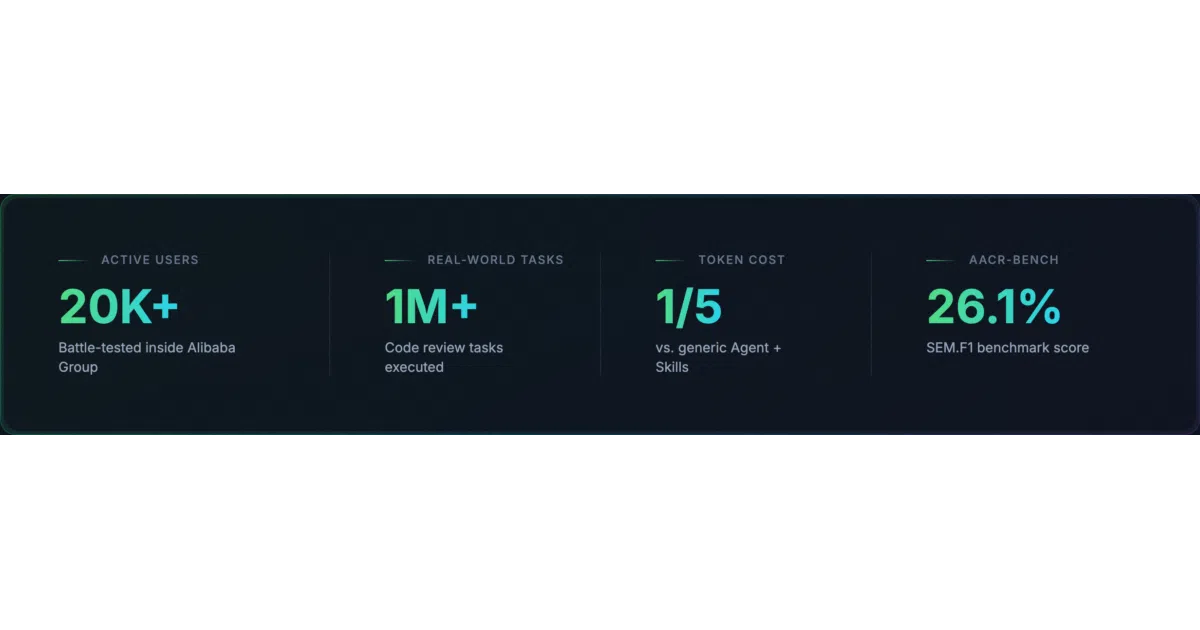
The agent is reserved for what it actually does well: dynamic context retrieval and semantic risk detection. It can search the codebase, read full files beyond the diff, and cross-reference changed files. The toolset is distilled from production traces—call frequencies, per-tool repetition rates, impact on call chains—rather than being a generic agent toolkit repurposed for review. The result, according to Alibaba’s internal benchmark, is a SEM.F1 score of 26.1% using Claude-4.6-Opus, versus 15.5% for the same model running inside Claude Code with generic Skills [3]. Token consumption is claimed to be one-fifth of the generic approach.
Those numbers deserve context. The benchmark was cross-annotated by over 80 senior engineers, which lends it credibility as a human-aligned metric, but it remains an in-house evaluation. And while a 26.1% F1 is significantly better than the competition in their table, it is still low in absolute terms—suggesting that even the best AI review systems today miss far more than they catch.
Where It Sits in a Crowded Field
The code review tooling landscape in 2026 has stratified into three layers. At the bottom, rule-based static analyzers like SonarQube Community Edition and Semgrep deliver deterministic, low-noise output that enterprises trust for compliance gates [1]. At the top, commercial AI platforms—CodeRabbit, Greptile, Qodo, and others—charge per-seat prices for multi-agent review, test generation, and repository-wide semantic context [4]. In the middle sits a graveyard of open-source AI experiments: unmaintained GitHub Actions, brittle local-model integrations, and generic agent skills that break on real monorepos [1].
Open Code Review is attempting to carve out a rare niche: production-grade, open-source AI review that is self-hosted and model-agnostic. It supports both Anthropic and OpenAI protocols, runs as a lightweight CLI binary, and emits machine-readable JSON for CI/CD pipelines. It can be embedded as a slash command inside Claude Code itself, turning the generic agent into a specialized reviewer. For platform teams allergic to sending proprietary code to third-party APIs, the local execution model is a genuine differentiator.
Yet the ceiling is visible. The Augment evaluation found that every open-source tool it tested, including the more mature PR-Agent and Tabby, reviewed files in isolation and failed to detect cross-service breaking changes [1]. Alibaba’s tool improves cross-file context by letting the agent search the repository, but it is not marketed as a full codebase-graph intelligence platform. It is an agent with tools, not a semantic context engine. If your monorepo spans four languages and hundreds of thousands of files, OCR will likely review the diff more carefully than a generic agent, but it may still miss the architectural ripple effects that commercial platforms with deep indexing catch.
Adoption and Integration
Alibaba claims over 20,000 active internal users and more than one million review tasks executed before the open-source release [3]. The project is distributed via NPM and GitHub Releases for macOS, Linux, and Windows, with a built-in web viewer for inspecting session traces. Configuration is minimal: point it at an LLM endpoint and run. It also auto-detects Claude Code environment variables, a small but telling design choice that signals the project expects to coexist with, rather than replace, developer workflows.
One intriguing use case mentioned in the documentation is for ML researchers: using OCR as a code quality verifier in reinforcement learning pipelines, providing reward signals for code generation models. That suggests the maintainers see the tool’s future not just as a DevOps utility, but as infrastructure for training better coding models.
Tensions and Open Questions
The most intellectually honest part of Open Code Review is its admission that LLMs alone are not enough. The hybrid architecture—deterministic engineering for certainty, agents for semantics—is a pragmatic response to the current state of models. But it also introduces a maintenance tension. As foundation models improve their reasoning and context windows expand, the hard-coded bundling, positioning, and reflection modules could become technical debt rather than guardrails. The project must prove that its deterministic layer is extensible enough to adapt as models change, without becoming the kind of brittle middleware that open-source projects often struggle to sustain.
There is also the question of community governance. Alibaba incubated the project internally and has now released it to the wild. Whether external contributors can meaningfully extend the rule engine or reflection modules—whether the architecture is truly open or merely published—will determine if OCR becomes a standard or a curiosity. As one analysis of modern review practices notes, AI review improves consistency only when paired with human judgment and proper context [5]. Open Code Review seems designed with that limitation in mind.
For now, it is one of the more credible open-source entrants in a space littered with half-finished experiments. It does not promise to eliminate human review, and it does not claim to understand your entire architecture. Instead, it offers a narrower, harder proposition: if you must use an LLM to review code, at least use one that is mechanically prevented from losing its place.
Sources
- 10 Open Source AI Code Review Tools Tested on a 450K-File ...
- What Is AI Code Review? - IBM
- What is your opinion on Open Code? : r/opencodeCLI - Reddit
- Which is best AI code review tool that you've come across recently?
- AI Code Review | Greptile | Merge 4X Faster, Catch 3X More Bugs
- Agent Native Code Review - Alibaba Open Source
- 13 Best Automated Code Review Tools in 2026: AI and Static ...
- Is AI Code Reviews something you use? : r/AskProgramming - Reddit
- GitHub - spencermarx/open-code-review: AI-powered multi-agent ...
- Best AI Code Review Tools for Developers in 2025 - YouTube
- 10 Best Practices That Will Transform Your Code Review Processes
- Opencode Is Probably The Best Coding Agent I've Ever Used