aiptimizer/TurboOCR · 05 Aug 2026 · Feature
The Anti-VLM Document Parser Built for Brute GPU Speed

Rachel Stein
Contributing Editor
TurboOCR argues that structured document understanding—OCR, layout, tables, and formulas—does not require a vision-language model if you are willing to write the pipeline in C++ and keep it on the GPU.
aiptimizer/TurboOCR
★1.1k stars
star history
The Hype Moment: Speed as a Counter-Argument
In a season where document parsing is increasingly synonymous with vision-language models, TurboOCR arrived with a deliberately contrarian pitch: no VLM, no API calls, no Python interpreter in the hot path—just a C++ binary, a stack of specialized PaddleOCR models, and enough CUDA streams to push an RTX 5090 to 559 receipt images per second. The project, released by aiptimizer and now at v3.0, has drawn attention across computer-vision and LLM communities for exactly this reason. Reddit threads on r/LocalLLaMA and r/computervision seized on the headline figures—500-plus images per second for raw OCR, roughly twenty pages per second for full structured parsing with tables and formulas—and framed it as a provocation against the prevailing wisdom that document understanding requires a large, generalist model.
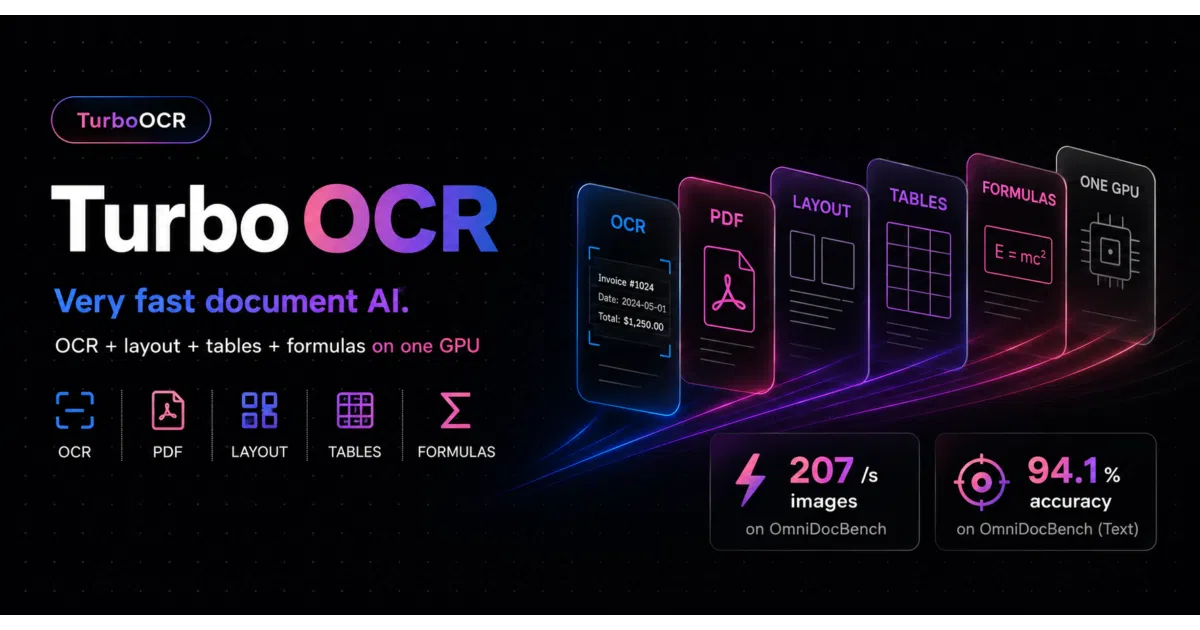
The timing matters. Enterprise pipelines are currently bifurcating between heavyweight VLM services that offer rich structure at the cost of latency and subscription pricing, and traditional OCR libraries that are fast but semantically blind. TurboOCR claims the narrow middle ground: Markdown output with reading order, HTML tables, and LaTeX formulas, produced locally at throughput rates the README advertises as fifteen to ninety times faster than classic engines and roughly twenty times faster than PaddleOCR-VL on the same hardware. That comparison is the heart of the hype. It is not merely fast; it is fast instead of using a VLM.
Anatomy of a Throughput Monster
The repository is not a new neural architecture. It is an integration and optimization layer, and its value lies in what it refuses to do. Rather than training a monolithic model, TurboOCR chains a set of existing, task-specific weights inside a single multi-stream TensorRT engine. Text detection and recognition use Baidu’s PP-OCRv6; layout analysis uses PP-DocLayoutV3, a 25-class RT-DETR-L model; tables route through SLANet-Plus; and formulas are handled by PP-FormulaNet-S. The entire pipeline—HTTP server, gRPC endpoint, PDF renderer, and post-processing—runs in C++20 behind the Drogon framework, with Prometheus metrics exposed for observability.
What makes this unusual is the strict opt-in design. Each stage loads only if configured at startup and runs only if requested in the API call. A client can ask for raw OCR, or add layout, or add tables and formulas; the server never silently falls back to a heavier path. This matters because VLMs and even many all-in-one OCR frameworks charge you for every capability on every page, whether you need it or not. TurboOCR treats the pipeline like a set of composable GPU kernels. The README notes that the default tiny tier covers Latin, Chinese, and Japanese text with a 1.7 MB detector and 4.3 MB recognizer, while small and medium tiers trade speed for accuracy on stylized fonts and dense scans.
The engineering is deliberately old-school in language choice and aggressively modern in runtime. NVIDIA’s own inference-optimization research has shown that converting detection and recognition models to TensorRT can yield two- to three-fold speedups over ONNX Runtime. TurboOCR pushes that philosophy across the entire document stack, baking the engines into a Docker image that auto-builds its TensorRT plans on first boot. The project also acknowledges its debt to PaddleOCR’s research weights, as well as to Google’s Wuffs decoder, PDFium, and the Clipper polygon library—vendored dependencies that keep the stack self-contained.
The Accuracy Tax
Speed without accuracy is a party trick, and TurboOCR’s authors are surprisingly forthcoming about the tradeoffs. On English receipt and form benchmarks, the medium tier scores 92% word-F1 on FUNSD and 93% on CORD, which the project describes as competitive with PaddleOCR-VL, RapidOCR, EasyOCR, and Tesseract. For full-document parsing on a 125-document OmniDocBench subset mixing English and Chinese pages, it scores 0.90 overall at roughly twenty pages per second, while PaddleOCR-VL scores 0.95 at about one page per second. The gap is small but real: you surrender roughly five points of accuracy for a twenty-fold latency improvement.
The README treats this not as a flaw but as a budget. It documents three “levers” to buy back accuracy—moving from tiny to small or medium, raising the detection resolution cap above the default 1280 px, and running the line-orientation classifier on every box instead of only vertical-looking lines. Each lever has a measured throughput cost, plotted in the project’s own benchmarks. This is the kind of operational transparency rarely found in open-source AI infrastructure, where projects often pretend that one default setting suits every scan.
It is worth contextualizing the headline numbers. The 559 images-per-second figure applies to small receipt images; dense documents drop to 200-plus, and full parsing with layout, tables, and formulas lands near 20 pages per second. Third-party benchmarks for standard PaddleOCR on an RTX 5090 report roughly 720 A4 pages per minute at batch 16—about twelve pages per second—in end-to-end tests. TurboOCR’s structured-parse claim therefore represents a meaningful but less dramatic leap over prior GPU-accelerated OCR than the raw receipt number implies. Still, twelve versus twenty pages per second is the difference between a batch queue and a real-time pipeline.
Who Is It For?
TurboOCR is built to be a sidecar, not a library. It exposes HTTP and gRPC, ships as a single Docker container, and includes health and readiness probes. That design aligns with a growing demand in the open-source self-hosting community for hardware-accelerated OCR workers that can live outside the main application. A feature request in the paperless-ngx repository, for example, explicitly asks for GPU-accelerated OCR sidecars to reduce ingestion time for large archives. TurboOCR is essentially a ready-made answer: a stateless, GPU-resident service that returns Markdown or JSON without ever touching a Python interpreter during inference.
Commercial backing comes from Miruiq and DiaIQ, two firms focused on AI-powered data extraction, which suggests the tool is being dogfooded in production document stacks. A LinkedIn post from the team acknowledges that “shortcomings were already addressed and more gaps will get closed soon,” noting that a Python API is in progress to improve ad-hoc scriptability. The project is young enough to admit its rough edges and mature enough to publish TensorRT build times, accuracy curves, and a thirty-five-variable configuration reference.
Rough Edges and Open Questions
The constraints are substantial. TurboOCR is Linux-only, requires an NVIDIA Turing-or-newer GPU, and needs roughly four gigabytes of VRAM for text-only work and eight for the full pipeline. First startup can take up to an hour on older cards to compile TensorRT engines, though an RTX 5090 finishes in about ninety seconds. There is no Python API yet; integration means HTTP calls or gRPC. And while the model stack supports Arabic, Cyrillic, Korean, Thai, and Greek through retained PP-OCRv5 recognizers, the project is fundamentally tied to the PaddleOCR ecosystem and NVIDIA’s stack.
The deeper question is architectural. TurboOCR is, at its core, high-performance glue. It does not invent new models; it optimizes existing ones. In a landscape where VLMs are improving monthly, the five-point accuracy gap on OmniDocBench could widen or narrow. If VLMs become cheap enough to run locally at comparable speed, the specialized pipeline approach may look like a transitional optimization rather than a permanent paradigm. Conversely, if document volumes continue to outpace GPU efficiency gains, the “specialized models + brute-force inference” strategy could become the standard for high-throughput extraction, with VLMs reserved for ambiguous or low-volume cases.
For now, TurboOCR has made the bet that most documents do not need a generalist model to be understood—they need a fast, deterministic pipeline that knows the difference between a paragraph and a table cell. That bet is paying off in attention, if not yet in ecosystem dominance.
Sources
- Scalable OCR Processing Using Multi-Core and GPU Architectures in Java ...
- Robust Scene Text Detection and Recognition: Inference Optimization
- TurboOCR — OCR Server
- OCR Speed and Hardware Optimisation | EasyData
- This repository provides optical character detection and recognition ...
- Turbo-OCR for high-volume image and PDF processing
- How Many OCR Pages per Minute per GPU?
- Development of a Low-cost Industrial OCR System with an End-to- ...
- TurboOCR vs Traditional OCR Performance Comparison
- Hardware Accelerated OCR Workers (NPU/GPU) · paperless-ngx ...
- 500+ img/s OCR, 20+ pages/s full parse (tables + formulas), no VLM
- TurboOCR parses 559 images per second on one GPU ...