agentscope-ai/QwenPaw · 29 Jul 2026 · Feature
QwenPaw and the Unusual Obsession with Securing Your Personal Agent

Claire Donnelly
Staff Writer
Alibaba’s AgentScope team built an open-source personal agent workstation that runs locally, chats across enterprise channels, and treats every third-party skill as potentially hostile.
agentscope-ai/QwenPaw
★36.4k stars Velocity · 7d +79 ★/day ↗accelerating
star history
The Rebrand and the Attention Spike
In April 2026, the repository formerly known as CoPaw was renamed QwenPaw—an abbreviation of Qwen Personal Agent Workstation—and the pace of development accelerated noticeably. By early June, the project had pushed v1.1.10, adding ephemeral sub-agent spawning, Tencent Yuanbao channel integration, and dynamic upload limits to a stack that already supported DingTalk, Feishu, WeChat, Discord, and Telegram. The GitHub star count sits at roughly 15.8 thousand, with 2.2 thousand forks. Those numbers are not accidental. A recent independent security audit published in Towards AI tested QwenPaw across eighteen real-world tasks and reported that its built-in guards intercepted five out of six deliberately planted attacks before a single line of code executed. In a crowded field of open-source personal assistants, that result is a more effective marketing campaign than any badge could provide.
What “Agent Workstation” Means in Practice
The personal AI assistant category has fractured into three rough tiers: model runners that chat with local LLMs, developer frameworks for building bespoke pipelines, and full personal assistants that hold identity, memory, and multi-channel presence. QwenPaw occupies the third tier, though it insists on the word “agent” rather than “assistant.” The distinction is not merely semantic. Industry analysis notes that true agents are proactive and goal-oriented, whereas assistants are reactive and prompt-dependent. QwenPaw attempts to bridge that gap with a memory-evolving layer that learns from interactions, a heartbeat system for scheduled check-ins, and cron-driven task execution. It also supports multi-agent collaboration: independent agents with distinct roles can communicate across skills, and as of v1.1.10, a parent agent can spawn ephemeral sub-agents inside a workspace to handle delegated work.
This architecture aligns with the research vision laid out in surveys on Personal LLM Agents, which argue that existing intelligent personal assistants have long suffered from limited practicality due to weak intent understanding, rigid task planning, and poor personal data management. Foundation models, the theory goes, finally offer the semantic reasoning needed to make personal agents scalable. QwenPaw is essentially an engineering bet on that thesis: it combines LLM reasoning with structured memory, tool use, and device-native integration in an attempt to solve the intent-planning-data triad.
The system is designed to live where you work. That means native integration with enterprise messaging channels—particularly the Chinese ecosystem of DingTalk, Feishu, and WeChat—alongside global platforms like Discord and Telegram. It also means local-first deployment: the default posture keeps data, memory, and configuration on the user’s machine, with model API keys isolated in a separate secrets store. When paired with local inference backends such as Ollama, llama.cpp, or LM Studio, the system requires no cloud API keys at all.
A Security Model That Assumes Hostility
The most genuinely unusual aspect of QwenPaw is its security stance. Most open-source assistants treat extensibility as a trust exercise: you install a skill or plugin and hope the author was benign. QwenPaw treats every skill as potentially hostile until scanned. The system runs automated security checks before installing or loading skills, hunting for prompt injection, command injection, hardcoded credentials, and data exfiltration patterns. A tool guard intercepts dangerous shell commands—the README explicitly names fork bombs, reverse shells, and recursive deletion of root directories—while a file access guard blocks traversal into sensitive paths such as SSH directories and system folders. Optional web authentication can lock down the console interface, though it is disabled by default.
The independent pen-test validated this architecture in the most useful way possible: by finding a partial failure. Five of six attacks sourced from documented agent-skill threat reports were blocked pre-execution. The sixth got through, and the researcher noted that the method of its escape was the most instructive part of the exercise. That admission of imperfection lends more credibility than a spotless score would have. It suggests the guards are functional engineering, not security theater. For a project that also offers local-only data storage and encrypted volume separation for secrets, the posture is closer to a hardened server process than to a friendly chatbot wrapper.
Deployment Breadth and the Beta Reality
QwenPaw ships with a deployment matrix wide enough to confuse a DevOps engineer. It can be installed via pip, a cross-platform shell script, Docker, Alibaba Cloud ECS, or ModelScope Studio for users who prefer a cloud sandbox. A Tauri-based desktop application is available for Windows and macOS, though the README is refreshingly blunt about its limitations: incomplete compatibility testing, potential memory and startup-time issues, and missing features. That honesty is rarer than it should be in open-source AI projects.
The local-first emphasis aligns with a broader 2026 trend toward privacy-first deployment. Market surveys cite privacy as a primary adoption driver for personal assistants, and QwenPaw’s architecture reflects that demand. Conversations are not uploaded to a third-party host; telemetry, which is collected anonymously during initialization, is limited to version numbers, install methods, OS details, and hardware availability. Even that can be declined, though the defaults flag auto-accepts it, a minor friction point for the paranoid. Docker deployments separate data, secrets, and backups into distinct volumes, an operational detail that signals the team has thought about production hygiene rather than merely demo convenience.
Skills, Sub-Agents, and the Agentic Tension
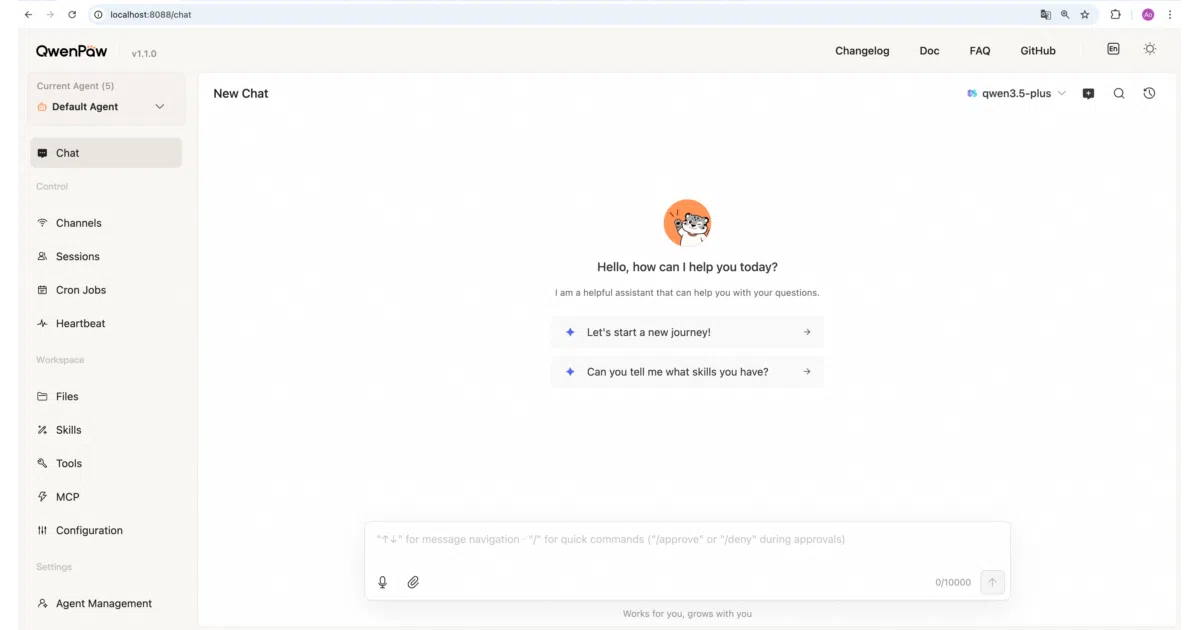
Capability is modular. The skills layer auto-loads custom modules, and the system ships with built-in support for scheduling, PDF and Office document processing, news digest generation, and web search. Version 1.1.8 introduced an official plugin distribution mechanism, turning the project from a monolithic assistant into an extensible platform. The sub-agent feature added in v1.1.10 allows an agent to instantiate temporary workers with scoped context, a pattern that mirrors enterprise orchestration frameworks more than simple chatbots. A three-panel web IDE and an “Open Directory” tab for referencing local projects without copying files further reinforce the “workstation” label.
Yet the project sits in a contested space. Critics of the current AI landscape argue that most “agents” are merely assistants with extra steps—reactive systems that require human prompting, not autonomous problem-solvers. QwenPaw’s roadmap acknowledges this tension. Planned features include an “insight system” to discover user needs through conversation, “tool self-evolution,” and sandboxed file access. These are genuine agentic ambitions, but they remain queued or under design. For now, QwenPaw is best understood as a sophisticated, security-first assistant with unusually rich multi-agent scaffolding.
Where It Fits
QwenPaw enters a market where enterprise adoption of agentic AI is accelerating, but where the definition of “agent” is still being negotiated. Ecosystem surveys place it alongside projects like OpenClaw, Vellum, and Hermes Agent, categorizing QwenPaw specifically as the option best suited for multi-agent workflows across enterprise messaging channels. That is a precise niche. It is not merely a local model runner like Jan.ai, nor a document-chat interface like AnythingLLM. It is an attempt to build a full personal agent that operates across the communication tools people actually use, with a security model that assumes the worst about third-party code.
The AgentScope team is clearly building an ecosystem—QwenPaw sits alongside the broader AgentScope runtime and the ReMe memory project—rather than a standalone toy. Whether the workstation vision matures depends on execution. The roadmap includes group chat, HiClaw enterprise capabilities, LSP-backed coding workspaces, and intelligent context compression. Those are heavy engineering lifts. If the team delivers, QwenPaw could become a reference architecture for personal agents that operate on-device and across corporate channels without treating user data as a consumable resource. If it stalls, it will still have raised the bar for what open-source assistants should demand of their own security layers. Either outcome makes it a project worth watching.
Sources
- QwenPaw — Works for you, grows with you.
- Personal LLM Agents: Insights and Survey about ...
- Real-world gen AI use cases from the world's leading organizations
- Docs - QwenPaw — Works for you, grows with you. - AgentScope
- Have you built an AI-powered personal assistant?
- 8 Best Open-Source Personal AI Assistants in 2026 - Vellum
- QwenPaw download
- Build your personal AI assistant with agents & tools 🤖🤖🤖 | Pavan Belagatti
- 21 Best AI Personal Assistants for Productivity in 2026
- I Planted 6 Attacks in QwenPaw's 18 Tasks — Its Guards Caught 5, and the ...
- Are We Confusing AI Assistants with AI Agents? | Manish Jain
- What's the best AI personal assistant? : r/AI_Agents