aakarim/OpenLore · 09 Oct 2026 · Feature
Your Agent Doesn't Need a Vector Database. It Needs grep.

Erik Johansson
Staff Writer
OpenLore bets that the missing piece of agent infrastructure isn't smarter retrieval — it's a governed filesystem every agent can share.
aakarim/OpenLore
★1k stars Velocity · 7d +69 ★/day
star history
There is a whole industry built on the premise that AI agents can’t find things. Mem0 sells memory infrastructure on the argument that context windows are an illusion of persistence. Redis pitches millisecond context serving. Fin advertises proprietary retrieval models hitting 96% accuracy where alternatives manage 78%. The shared assumption: the bottleneck between an agent and the knowledge it needs is retrieval, and the fix is embeddings, rerankers, and vector search.
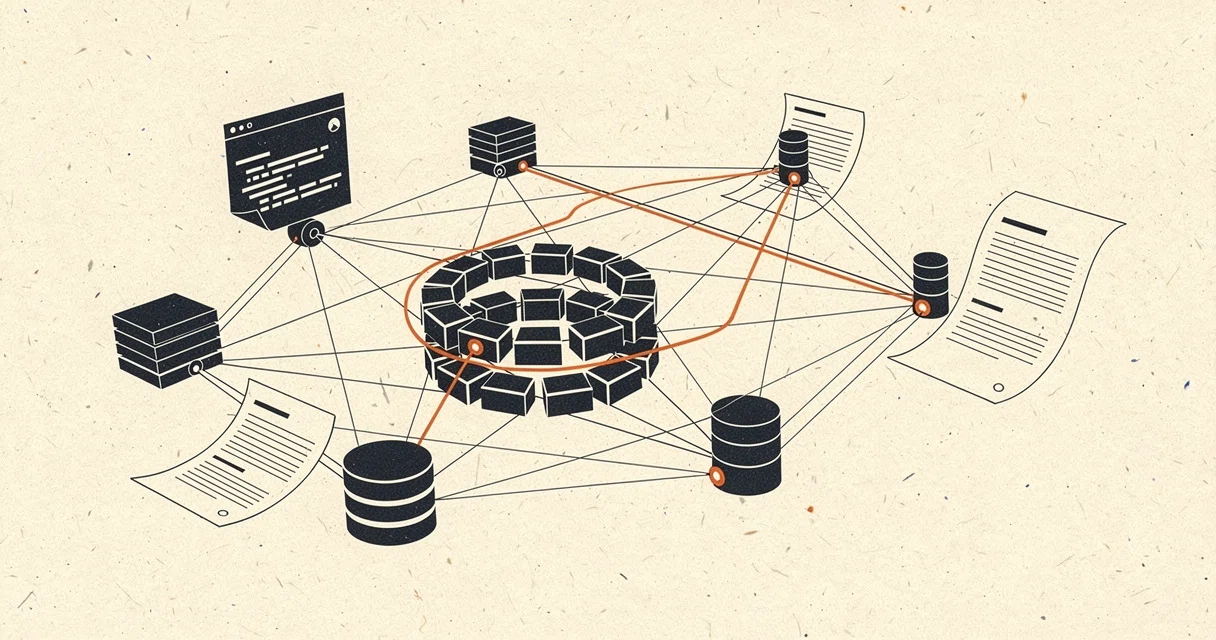
OpenLore, the Go server from Adil Karim, takes the opposite position. There is no ingestion pipeline, no vector database, and no LLM anywhere in the hot path. Agents connect over SSH and get a filesystem — a real one, with directories and plain Markdown files — and they read it with the tools they already use a thousand times a day: listing, cating, grepping, finding, piping. The project’s actual claim is that retrieval was never the hard part. The hard part is that knowledge gets copied, goes stale, and has no consistent owner.
That’s a contrarian bet, and it’s worth taking seriously.
A filesystem is the interface
Mechanically, OpenLore is a single Go binary, Apache 2.0 licensed, built on Charm’s Wish library for SSH transport. Point it at a documentation directory and it serves that directory as a virtual filesystem: SSH on one port, a human-facing web view and an MCP endpoint on another, plus SFTP and SSHFS so a human can browse and edit the same tree directly from VS Code. If the backing directory changes, agents see the change on their next read — there’s no reindex step to forget. Documentation can also be embedded into the binary itself, which makes those bundles permanently read-only and trivially portable; a GitHub Action produces cross-platform builds with docs baked in, and the same knowledge can ship as a desktop MCP extension.
The unglamorous detail doing the heavy lifting: the shell agents get is an in-memory Go interpreter, not an operating-system shell. It implements the familiar commands as pure Go functions over the virtual filesystem. It cannot invoke bash, exec, curl, or any host process, and a normal session has no ambient network access. This is the rare security posture that can be described as “safe by construction” without marketing shame — the attack surface isn’t defended, it’s absent. The trade-off is real, though: agents that legitimately need to run jobs against the knowledge base can’t, unless an administrator explicitly grants a narrowly scoped asynchronous processing capability to a trusted identity.
The boring part is the point
Here is where OpenLore stops being a clever SSH trick and becomes infrastructure. Every connection resolves to an identity — an SSH key, certificate, passkey, or OAuth login. Each identity gets a composed view: only the docsets and paths that identity was granted are mounted, with role-based access at three levels (read-only, publish, read-write), path aliases, and private home directories. One server, one authorization model, many agents, each seeing a different filesystem.
The OAuth path is where the design gets genuinely thoughtful. Delegated identities are distinguished in write provenance — the logs can tell the difference between work done directly by a person and work done by that person’s agent acting through a vendor’s cloud. A delegate inherits no more authority than its principal and can be narrowed further by docset and capability deny lists. There’s even support for workload identity federation, so CI jobs and agents authenticate with short-lived external tokens instead of long-lived secrets.
This is the part a folder of Markdown in your repo cannot give you, and it’s the honest answer to the README’s own question of why you’d bother. For one agent in one repository, in-repo docs are fine. The moment multiple agents, repositories, or teams need the same knowledge, you’re into copying files, version skew, and no way to control who can read or publish what. OpenLore’s pitch is that this is a permissions problem wearing a documentation costume.
Against the semantic search grain
The knowledge-base industry’s own diagnostics arguably support OpenLore’s read of the situation. Decagon cites research that 62% of agents report their help materials aren’t current, and identifies fragmentation across platforms as a core failure mode. IBM’s primer on agent memory flags retrieval efficiency as a central design challenge. Notice what these problems have in common: they’re staleness and fragmentation, not phrasing. Semantic search solves the case where a customer writes “my package never showed up” and the article says “missing shipment policy.” A coding agent grepping a runbook for “authentication” does not have that problem.
OpenLore’s wager is that for this class of consumer — agents that already compose shell pipelines fluently — deterministic, inspectable retrieval beats probabilistic retrieval. An agent can see exactly which file it read and quote the line. Nothing is hidden behind a reranker. The counterargument the RAG vendors would raise, and which the sources here don’t resolve, is scale: grep degrades gracefully but not infinitely, and OpenLore publishes no benchmarks on retrieval quality or token savings comparable to the numbers its semantic-search competitors throw around. Its claim is architectural, not measured — at least in everything provided here. The project’s own site is candid about one adjacent limit: per-document token counts are estimates, not gospel.
Writes that don’t lie to you
The read path is only half the design. OpenLore is read-only by default, and writable deployments funnel everything — publishing, appends, patches, sed-style edits, file moves — through a single policy-controlled write path. Writes are whole-object atomic swaps with compare-and-swap protection, so a stale edit gets rejected rather than silently clobbering a concurrent one. Plugins can validate or defer a write before it commits, and the project leans on Google’s Open Knowledge Format for bundle validation close to the write path. Frontmatter is inspectable as NDJSON and queryable with jq, which gives you structured metadata without inventing a query language — a small decision that quietly respects how much agents already know.
The use-case list this enables is longer than the tool: shared live memory for teams of agents, inbox-style contribution where outside agents can publish but never overwrite, governed skills collections, even a public docs endpoint for agents that stumble onto your site. The through-line is the same: one source of truth, admission control at the boundary.
A name collision worth knowing about
A practical warning for anyone searching: there are two projects called OpenLore, and they solve different problems at different layers of the stack. The other one, clay-good/OpenLore, is a deterministic, local-first memory and guardrails tool for coding agents — a one-time static analysis that builds a live knowledge graph of your codebase’s call structure, types, tests, and spec drift, with no LLM in the hot path. It indexes ripgrep’s 235 files and 2,978 functions in 14 seconds, claims a 26% reduction in agent round-trips, and reports orientation latencies around 430 microseconds on a 15k-node graph, per its directory listings. It has the modest-but-real traction those directories show — 137 stars on one, 319 on another.
Karim’s OpenLore, by contrast, serves your documentation — the runbooks, product context, and accumulated knowledge around the code, not the code’s structure itself. They’re complementary more than competitive, which won’t stop the search results from being a mess for both projects.
Rough edges
The project is young and effectively the work of one maintainer, sponsored by a company called Oiya — worth knowing when you’re evaluating whether to route your team’s entire knowledge surface through it. The deployment story is more elaborate than the tool itself: published containers deliberately ship with no configuration, expecting config to be projected onto a persistent volume separately, and the docs are honest about an awkward infrastructure limit — raw SSH has no hostname or SNI routing, so one listener can’t serve multiple domains on port 22, pushing you toward dedicated addresses or external TCP forwarding. There’s also a hosted endpoint that streams setup instructions directly into an agent’s CLI, letting the agent teach itself to install and configure the server. It’s a clever demonstration of the thesis — agents as first-class operators — and also a very 2026 sentence.
Outlook
The open questions are the ones you’d expect. Does grep-scale hold as docsets grow into the tens of thousands of files? Will the governance machinery — OAuth delegation, CIMD clients, workload federation, plugin middleware — prove to be the durable value, or more ceremony than small teams will tolerate? And can a single-maintainer project become the shared substrate it’s designed to be, given that its whole point is being the one thing everyone agrees on?
But the underlying observation is sound, and it’s bigger than this repo. The agent-memory discourse keeps framing the problem as making stateless models remember. OpenLore reframes it: agents are just another class of user — ones who type fast, never get bored, and already speak filesystem. Users like that don’t need a smarter brain attached to the documents. They need the documents to be current, shared, and governed. The boring answer, as usual, is the one nobody’s building — which is exactly why someone finally did.
Sources
- OpenLore — A knowledge base for AI agents
- What Is AI Agent Memory? | IBM
- Knowledge base AI systems – how they really work - Decagon
- clay-good/OpenLore: Deterministic, local-first memory and ...
- AI Agent Memory: Complete Guide & Architecture
- What are you using for a shared, agent-native knowledge ...
- OpenLore: Persistent Architectural Memory for AI Agents
- AI agent memory: types, architecture & implementation
- AI Knowledge Base: The Complete Guide for 2026 - Fin AI Agent
- OpenLore - AI Agents on GitHub
- AI agent for knowledge management: Key capabilities, use ...
- AI Knowledge Base: What It Is and Why It's Crucial to AI ...