Zackriya-Solutions/meetily · 10 Jul 2026 · Feature
Local AI, Local Audio: Meetily’s Bet Against Cloud Notetakers

Jordan Ellis
Senior Editor
A privacy-first desktop app that transcribes and summarizes meetings entirely on your hardware, using open-source models and a Tauri-based stack to challenge SaaS notetakers.
Zackriya-Solutions/meetily
★31.5k stars Velocity · 7d +31 ★/day ↘cooling
star history
The Attention Spike
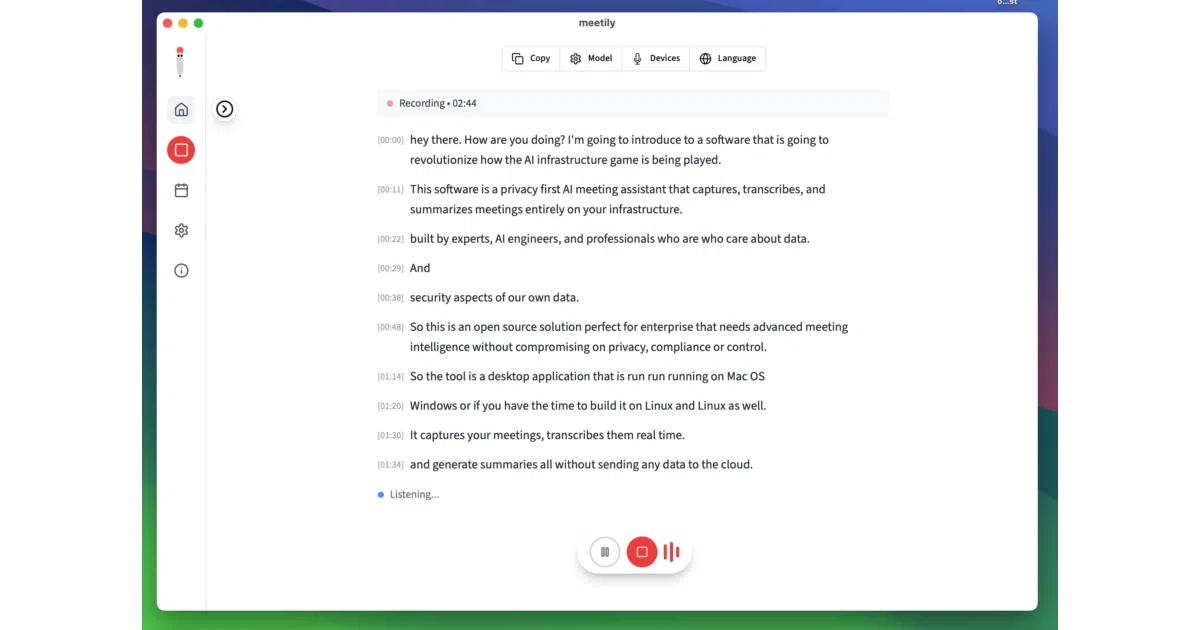
Meetily has become an unlikely GitHub phenomenon. According to figures displayed on its project site, the repository has accumulated more than twenty thousand stars and over three hundred thousand downloads [3]. On r/selfhosted, a community notoriously skeptical of cloud services, it has surfaced repeatedly as a reference implementation for local meeting intelligence [3]. The timing is not accidental. The project arrives as enterprise anxiety over data sovereignty is peaking: its own documentation cites an average data-breach cost of $4.4 million and cumulative GDPR fines reaching billions, framing cloud-based notetakers as latent liabilities. For defense consultants, healthcare providers, and legal professionals who cannot let sensitive conversations touch a vendor’s server, the appeal is obvious. Meetily does not ask for trust; it removes the need for it by keeping the microphone stream inside the machine’s memory.
The broader context is a meeting software market that has already been thoroughly colonized by SaaS. Industry surveys suggest business teams spend more than fifteen hours a week in meetings, with a large majority of employees judging those meetings unproductive [5]. AI notetakers like Otter.ai, Fireflies.ai, and Read.ai have rushed in to reclaim that time, but they do so by centralizing audio archives on infrastructure the user does not control [1][9]. Meetily’s bet is that a growing faction of users would rather reclaim time than reclaim storage space on someone else’s hard drive.
Architecture and the Local-First Promise
Where most AI meeting assistants join calls as third-party participants—silent bots that record from the cloud—Meetily is a desktop application built with Tauri, pairing a Rust backend with a Next.js interface. It captures audio at the operating-system level, mixing microphone input and system audio simultaneously while applying ducking and clipping prevention. This design sidesteps the “bot fatigue” that plagues platforms like Zoom and Google Meet, where calendar-invited notetakers occasionally fail to dial in or clutter the participant list. Because it is a local binary rather than a browser extension, it can access hardware acceleration directly.
Transcription runs locally through open-source models: OpenAI’s Whisper or NVIDIA’s Parakeet, the latter served via an ONNX conversion. Hardware acceleration is automatic and cross-vendor: Apple Silicon uses Metal and CoreML, NVIDIA cards use CUDA, and AMD or Intel integrated graphics fall back to Vulkan. Summarization is similarly flexible. Users can route transcripts to an entirely local Ollama instance, or bring their own keys for Claude, Groq, OpenRouter, or any OpenAI-compatible endpoint. The result is a tool that can operate in a fully air-gapped environment or, if a user prefers, leverage cloud intelligence only for the final text-generation step. In either mode, the raw audio never leaves the device.
The contrast with the mainstream market is stark. Review roundups from Zapier and Lindy describe an ecosystem dominated by cloud-native services such as Otter.ai, Fireflies.ai, Read.ai, and Gong—tools that transcribe from the server side and then sync to Slack, Salesforce, or Notion [7][12]. Otter.ai, for instance, advertises itself as a “conversational knowledge engine” that stores meeting archives for cross-meeting search and CRM push [1]. Read.ai offers a “digital twin” and multi-platform coaching [9]. Meetily offers none of these integrations. Its value proposition is architectural: data never transits a network pipe the user does not control.
A Curated Stack, Not a Reinvention
The codebase is candid about its lineage. It borrows transcription logic from whisper.cpp, audio pipeline code from Screenpipe, and additional plumbing from transcribe-rs; its Parakeet integration relies on an upstream ONNX conversion. In other words, Meetily is not a fundamental research breakthrough. It is a high-quality integrator, packaging proven open-source engines inside a single installable binary with hardware-accelerated inference and a polished UI. That is a harder engineering problem than it sounds. Getting Rust-based audio capture, GPU scheduling, and a Next.js frontend to ship as one cross-platform desktop app is precisely the kind of tedious systems work that turns a collection of models into a product. The project’s value lies in its defaults: privacy is the configuration, not a setting.
By leaning on whisper.cpp, Meetily inherits a C++ inference engine that has been battle-tested across millions of hours of audio. Parakeet, meanwhile, is a NVIDIA research model optimized for speed, and the ONNX packaging allows it to run outside NVIDIA’s proprietary stack. The frontend, rendered in Next.js but wrapped by Tauri, avoids the memory bloat of Electron while still giving the developers a modern React toolchain. None of these choices are flashy, but together they explain why a small team can ship a responsive local application that rivals the perceived speed of cloud APIs.
The Open-Core Squeeze
Meetily’s sustainability strategy follows the familiar open-core playbook. The Community Edition is MIT-licensed and free, offering real-time transcription, local storage, and pluggable AI summaries. Meetily Pro, by contrast, is a separate codebase pitched at professionals and teams. It promises superior transcription accuracy, custom summary templates, PDF and DOCX exports, auto-meeting detection, and eventually speaker diarization and calendar integration [6]. Pro also offers self-hosted deployment for organizations that want centralized management without surrendering data to a SaaS vendor.
This bifurcation creates tension. Features that are table stakes in the established ecosystem—speaker identification, CRM sync, automated meeting joining—are currently marked “coming soon” inside the paid tier. The community edition risks becoming a gateway drug rather than a fully capable alternative. The project insists the open-source core will remain “free forever,” yet the roadmap suggests the most advanced capabilities will live behind the Pro paywall. Whether the community fork stays vibrant depends on whether the maintainers can balance generosity with the revenue required to ship those advanced features. The pricing page lists an annual plan, signaling that the team is betting on low-friction, per-user subscriptions to fund development [6].
The separation of the codebases is worth noting. Because Pro is built on a different foundation, community contributors cannot simply port enterprise features downstream. This is a pragmatic business decision, but it also means the open-source edition may evolve more slowly, dependent on volunteer patches rather than the full-time engineering effort driving Pro.
Rough Edges and Competitive Reality
Meetily is still pre-release software. macOS and Windows users receive native installers, but Linux remains a build-from-source exercise with no native desktop package yet [6]. The project also lacks the deep integration fabric that defines mature competitors. WSI World’s survey of the notetaker landscape highlights how incumbent tools reclaim hours by automating follow-ups and slotting directly into CRM pipelines [5]. Meetily has none of that. Its export options in the community edition are limited to copy-and-paste Markdown; advanced document formats are reserved for Pro.
Accuracy claims are another soft spot. The project’s site quotes users calling transcription “impressive,” but no word-error-rate benchmarks are published against cloud APIs or human transcription [3]. For users who prioritize confidentiality over marginal gains in precision, this trade-off is acceptable. For teams accustomed to the polish of Gong or Otter, it may feel like a step backward in exchange for control.
There is also a credibility gap in compliance marketing. Read.ai advertises SOC 2 Type 2 certification alongside its GDPR and HIPAA claims [9]. Meetily’s documentation does not list third-party audit credentials, relying instead on architectural isolation—local processing—as its compliance story. That argument is logically sound, but enterprise procurement teams often demand paperwork, not just philosophy.
Why It Matters
Meetily is best understood as a bellwether for the post-SaaS AI tool. A testimonial aggregated on its site captures the sentiment: “Every SaaS will live just long enough to have an open source competitor kill them” [3]. The project validates that local LLM tooling—Ollama, Whisper.cpp, and modern ONNX runtimes—has matured enough to replace cloud APIs for narrow, high-stakes domains. It also demonstrates that Tauri can shoulder serious desktop AI workloads, not just lightweight utilities.
The open question is sustainability. If Meetily Pro can deliver enterprise features like speaker diarization and calendar-aware recording while the community edition remains a stable, privacy-first baseline, the project could become the default choice for regulated industries. If the gap between free and paid grows too wide, or if the pre-release roughness persists, it may remain a niche favorite for the paranoid. Either way, it has proven that the meeting assistant market finally has a credible off-ramp from the cloud.
Sources
- Otter Meeting Agent - AI Notetaker, Transcription, Insights
- Building a Fully Open-Source Local LLM-Based Ai for Recording ...
- Meetily (Meetly AI) - Privacy-First AI Meeting Assistant
- What's the Best Meeting Transcription App?
- AI Note Taking Tools: Weapon for Business Productivity - WSI World
- Download Meetily - AI Meeting Assistant | Community & ...
- The 10 best AI meeting assistants in 2026
- Meetily v0.0.5 with ollama support and whisper ...
- Meeting Summaries, Transcripts, AI Notetaker & Enterprise ...
- Best AI Meeting Notes and Summary Software: No Bots ... - YouTube
- Meetily download
- The 10 Best AI Transcribers for Teams in 2026