Unclecheng-li/VulnClaw · 11 Jul 2026 · Feature
Speak Human, Exploit Machine: Inside VulnClaw's LLM Pentest Loop

Minh Tran
Contributing Editor
A Python CLI tool that turns natural language into autonomous offensive-security workflows, openly admitting that most of its third-party tool integrations are still placeholders.
Unclecheng-li/VulnClaw
★2k stars Velocity · 7d +210 ★/day ↗accelerating
star history
The Hype Moment: Conversational Offense
The security tooling landscape has long suffered from a user-interface problem. Reconnaissance, exploitation, and reporting each demand fluency in distinct syntaxes—nmap flags, Burp intruder payloads, Metasploit resource scripts, and the Markdown dialects of final reports. VulnClaw, an open-source Python CLI project by Unclecheng-li, bets that this complexity can be collapsed into a single prompt. Its tagline, roughly translated from the Chinese README, invites users to “speak human language, hit vulnerabilities.” That sentiment captures the current hype cycle perfectly: large language models have matured enough to serve as interpreters between human intent and low-level system tooling, and security practitioners are eager to see if offensive workflows can be agentified without turning into either a toy or a compliance nightmare.
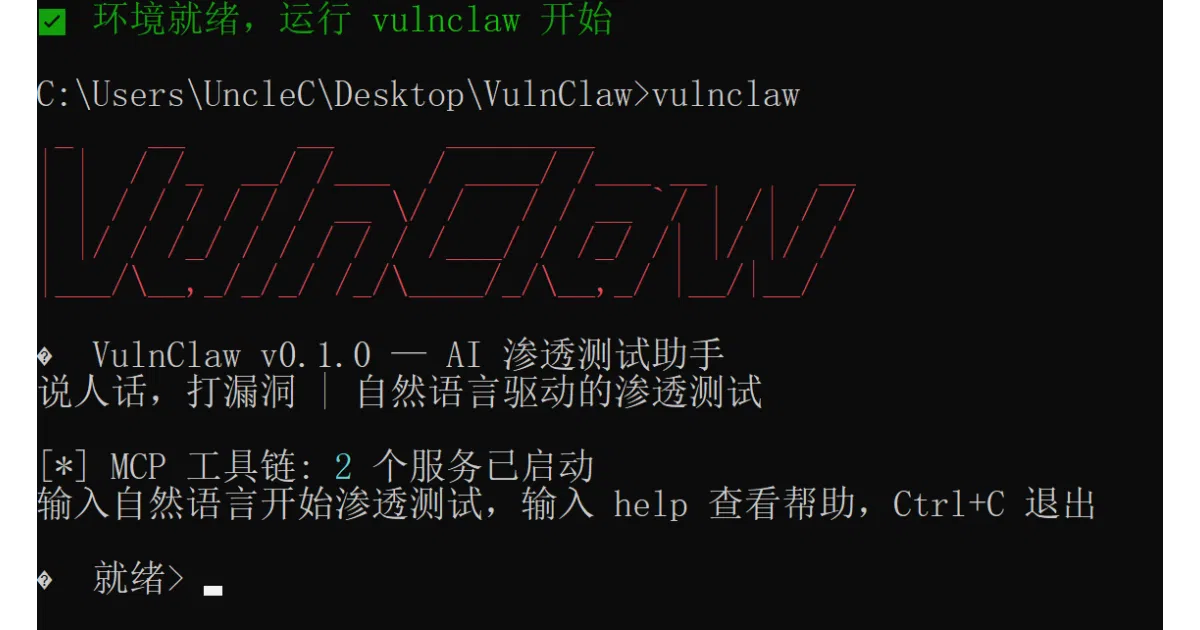
The idea is seductive: replace the brittle bash pipeline between recon and exploitation with an LLM that decides what to run next. The repository has accumulated roughly two thousand GitHub stars and 261 forks, according to a third-party evaluation, and sits at a crowded intersection where AI-agent frameworks meet penetration-testing methodologies [3]. What makes it notable is not the ambition—autonomous pentesting is already the marquee feature of heavier platforms—but the packaging. VulnClaw is pip-installable, runs a local TUI or Web UI on a laptop, and attempts to orchestrate the full kill chain from port scanning to Python proof-of-concept generation inside a single conversational loop.
The Architecture: Agent, Skills, and Brutal Honesty
At its core, VulnClaw is an OpenAI-compatible LLM agent with tool calling and a curated set of “Skills.” The project supports thirteen LLM providers, ranging from OpenAI and DeepSeek to domestic Chinese models such as MiniMax, Zhipu, and SenseTime, allowing operators to swap backends without rewriting prompts [3]. This breadth is unusual for a niche open-source security tool and signals an attempt to remain provider-agnostic in a market where API availability is geographically fragmented.
The agent’s hands are the Model Context Protocol (MCP) toolchain. The README lists twelve configured MCP services and twenty-three tool definitions, covering HTTP fetching, memory persistence, browser automation via Chrome DevTools, Burp proxy interop, and mobile hooks through Frida [3]. Here is where the project’s candor becomes almost disarming: it openly states that only fetch and memory currently run in a stable local mode. The remainder—Burp, Frida, JADX, IDA Pro—are largely preview or placeholder integrations awaiting a proper session lifecycle management layer before they speak real MCP protocol [3]. Most projects bury such gaps in issue trackers; VulnClaw prints them in the feature list.
Domain knowledge arrives through twenty-one penetration-testing Skills, seven core and fourteen specialized. These are not executable binaries but structured prompt context: reconnaissance playbooks, WAF-bypass technique libraries, CTF Web and Crypto attack knowledge bases, and an OSINT four-dimensional model covering servers, websites, domains, and personnel [3]. The secknowledge-skill module integrates thirty-nine reference documents drawn from public security methodologies and CTF write-ups, loading them on demand when the agent detects keywords such as SRC, OWASP, or GAARM [3]. This is not retrieval-augmented generation in the vector-database sense—there is no mention of embeddings or chunking—but a simpler conditional prompt injection that nevertheless keeps token counts lower than dumping an entire textbook into every request. When the agent needs to decode a JWT or iterate a Caesar cipher, it can call one of twenty-nine built-in codec operations rather than hallucinating the transformation.
A less visible but more interesting architectural choice is target-state inheritance. The project accumulates findings across rounds, supports snapshots, and allows rollback when the agent drifts [3]. Combined with an anti-loop detector that forces a strategy switch after a configurable threshold of stale rounds, the system acknowledges that LLM-driven pentests can easily spiral into repetitive HTTP requests or redundant port scans. Statefulness is the difference between a chatbot with a shell and an agent that remembers it already checked port 8080.
What the Loop Looks Like in Practice
The operator enters a target and a plain-language intent—something like “perform a penetration test on 192.168.1.100.” An input-analysis module extracts the target and infers the desired phase. The agent then enters an autonomous loop: Round 1 reconnaissance fingerprints services and enumerates directories; Round 2 hunts for injection points and known CVEs; Round 3 attempts proof-of-concept validation; Round 4 emits a structured Markdown report and a standalone Python PoC script [3]. A dedicated CTF workflow flips the priority from vulnerability discovery to flag-hunting, adjusting the skill dispatcher to prioritize web-application attacks, cryptography challenges, and miscellaneous jailbreak puzzles [3].
The TUI workbench pauses before execution to display authorization scope, allowed actions, and constraint history, letting the operator forbid exploitation or post-exploitation before the first packet is sent [3]. For long-running engagements, a persistent mode runs one hundred rounds per cycle across up to ten cycles, preserving cross-cycle state and generating incremental reports that distinguish newly discovered vulnerabilities from cumulative totals [3]. The Web UI, built with React and Vite according to library metadata, binds to localhost by default, keeping the interface local unless explicitly exposed [9]. It is a pragmatic, laptop-first design philosophy that assumes the operator is physically present and authorized, not running a distributed red-team cloud.
The Competitive Landscape: Lightweight vs. Heavyweight
VulnClaw is not the only attempt to hand an LLM a terminal and a target. PentAGI, a more mature open-source project with nearly twenty thousand stars, offers a fully containerized platform: sandboxed Docker environments, a Kali Linux tool suite, Neo4j-backed knowledge-graph memory, PostgreSQL history tracking, and Grafana observability [1][4]. PentAGI is designed for enterprise infrastructure and self-hosted deployment, with Langfuse integration and support for local inference via Ollama [4]. PentAGI’s knowledge graph, powered by Graphiti and Neo4j, offers semantic memory that VulnClaw’s SQLite session store does not attempt to replicate; the comparison is less about feature parity and more about weight class [4].
By contrast, VulnClaw is deliberately lightweight. It stores session state in SQLite, emits local Markdown reports, and requires no container orchestration [3]. The trade-off is isolation: PentAGI runs everything in Docker; VulnClaw executes Python code through a built-in python_execute tool that the documentation labels a “high-risk experimental capability” and explicitly warns is not a hardened sandbox [3]. One platform bets on enterprise containment; the other bets on accessibility, with the honest caveat that you should probably not aim it at production targets unless you trust both the agent and the host machine.
Rough Edges and Honest Warnings
The project’s self-awareness about its own limitations is perhaps its most distinctive trait. The configuration file stores LLM API keys in plain YAML without built-in encryption, and the evaluation notes that production deployments should review vulnclaw config security practices carefully [3]. All test data, prompts, and findings are forwarded to whichever external LLM provider the operator selects, raising the usual data-sovereignty concerns that accompany cloud-based inference [3]. For corporate red teams, this means every banner grab and error message may transit a third-party API, turning a scoped internal test into an inadvertent data-sharing event. There is no offline mode; air-gapped use would require re-pointing the base URL to a locally hosted compatible endpoint and hoping the model’s tool-calling behavior remains consistent.
Behavior is also non-deterministic. The agent’s tool selection, payload mutation order, and reasoning path vary with LLM sampling, meaning two runs against the same target may diverge [3]. For compliance-minded teams, this unpredictability makes audit trails harder than traditional scripted scanners. The project is not presented as SOC2 or ISO27001-ready, and the TUI’s scope controls rely on operator discipline rather than kernel-level enforcement [3]. The Web UI, while convenient, defaults to localhost and requires an explicit flag to bind outward—a sensible default, but one that underscores the project’s assumption of single-operator, single-machine usage [3].
Why It Matters for AI and Security
VulnClaw arrives at a moment when the security community is still negotiating how much trust to place in generative models. A recent design-science study involving twelve cybersecurity experts found that practitioners are willing to use LLMs for initial risk assessment and threat identification, but prefer them in assistance roles rather than as sole authorities [2]. The researchers emphasize human oversight, noting that models can generate draft findings and redundancy checks while experts retain final judgment [2]. VulnClaw’s design aligns with that division of labor: it automates the tedious toolchain orchestration and report scaffolding, yet keeps the human in the loop through TUI confirmation gates and interruptible REPL sessions.
Broader industry context reinforces both the opportunity and the peril. Security researchers have already demonstrated that iterative prompting can produce fully functional command-and-control platforms without manual coding [5]. Meanwhile, enterprise security vendors warn that LLM-based systems themselves face prompt-injection, data-leakage, and malicious-output risks [11]. VulnClaw sits squarely in the middle of this tension: it uses an LLM to attack other systems, while relying on that same LLM’s reasoning to stay within authorized boundaries. The safety model is essentially “please be good,” backed by a red badge that reads “Authorized Only.”
Outlook
Version 0.3.x is still early software. The MCP ecosystem integration is incomplete, the knowledge-base retrieval is only gradually being wired into the main flow, and the Web UI is a convenience layer rather than a full management plane [3]. The next few releases will likely determine whether VulnClaw matures into a reliable teaching assistant or stalls as an ambitious glue layer between Typer and an OpenAI completion endpoint. Yet the project’s honesty about these gaps—combined with a genuinely useful pip-installable agent loop, broad provider support, and stateful target tracking—gives it a niche between one-off Python scripts and monolithic autonomous platforms. If the maintainers deliver on the promised session lifecycle management and harden the Python execution boundary, VulnClaw could become a standard component in the CTF and authorized-testing toolkit. For now, it is a sharp, self-aware experiment in letting an LLM hold the shell—and a reminder that the most interesting security tools right now are the ones that admit exactly how fragile they are.
Sources
- vxcontrol/pentagi: Fully autonomous AI Agents system ... - GitHub
- Leveraging Large Language Models for Cybersecurity Risk ... - arXiv
- VulnClaw: AI-Powered Penetration Testing CLI
- PentAGI - Advanced AI-Powered Penetration Testing
- Practical Use Cases for LLM's in cyber security (part 1) - Dan Lussier
- VulnClaw
- The Top AI Pentesting Tools for LLMs and Autonomous Agents
- Generative AI in cybersecurity: A comprehensive review of LLM ...
- Unclecheng-li/VulnClaw - Online Tools
- I built an open-source AI agent that runs pentest autonomously ...
- What Is LLM (Large Language Model) Security? | Starter Guide
- AI Agentic Cybersecurity Tools: Reaper, TARS, Fabric Agent Action ...