Tencent/WeKnora · 17 Sep 2026 · Feature
WeKnora: Tencent’s Bid to Make Enterprise RAG Boring

Andrei Popescu
Staff Writer
Tencent’s open-source knowledge framework wants to turn scattered documents into a self-updating, permissioned corporate wiki, and the GitHub stars suggest enterprises are paying attention.
Tencent/WeKnora
★25.4k stars Velocity · 7d +487 ★/day ↗accelerating
star history
The Star Count and the Signal
Something unusual is happening in the open-source RAG trenches. Tencent’s WeKnora, an enterprise knowledge framework maintained by the Weixin (WeChat) team, has accumulated more than 22,000 GitHub stars and added over 1,100 in a single week [3]. For a project whose README leads with tenant RBAC matrices and AES-256-GCM credential encryption, that velocity is a signal. It suggests the market is done admiring research prototypes and is ready to install them behind corporate firewalls.
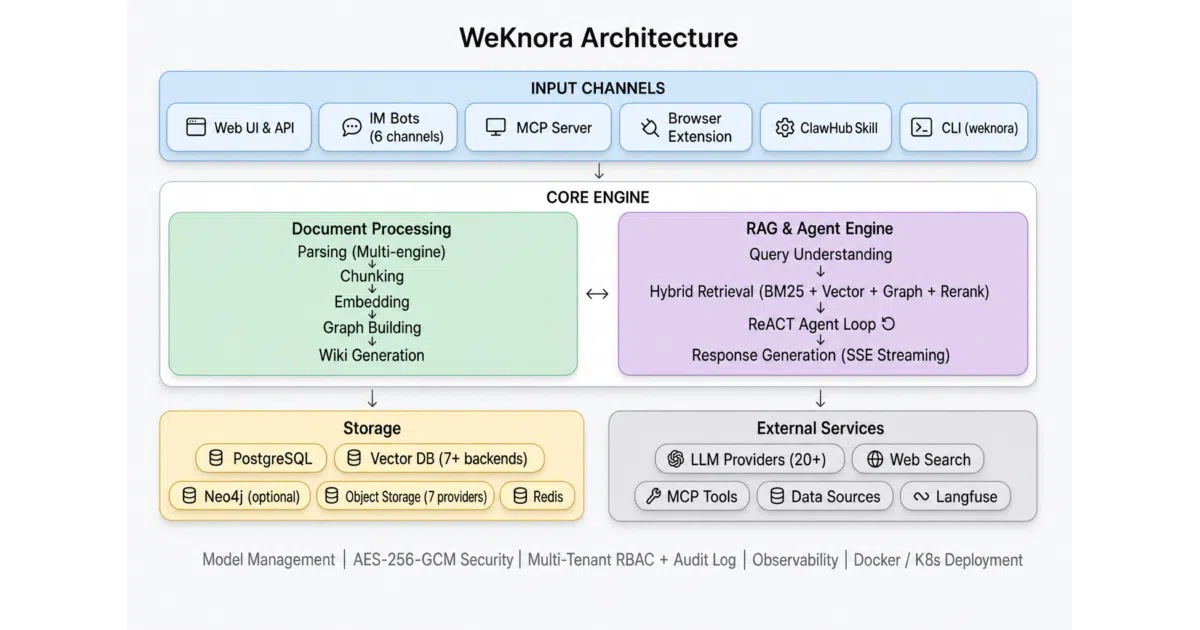
The timing is not accidental. Industry observers note that 2024 marked the pivot from experimental retrieval-augmented generation to production-grade enterprise deployment, with hardened error handling, observability, and privacy enforcement becoming non-negotiable [10]. WeKnora arrives precisely at this inflection point, offering a fully modular pipeline from document parsing to LLM inference that can be self-hosted on private clouds or local hardware [9]. It is a long way from the early generation of in-house document-QA stacks, which typically glued together LangChain, a local Hugging Face model such as Falcon, and a basic PDF loader to keep data on-premises [2]. In other words, WeKnora is trying to make enterprise RAG boring—which, in infrastructure, is the highest compliment.
Three Modes, One Ambition
Most open-source document-QA projects stop at chat-with-your-PDF demos. WeKnora organizes itself around three distinct capabilities, and the third is what separates it from the glut of vector-database wrappers.
The first is standard RAG-based Q&A: dense retrieval over uploaded documents with sparse BM25 fallback and parent-child chunking. The second is a ReAct agent that orchestrates knowledge retrieval, MCP tools, and web search when internal documents are insufficient. Both are now table stakes for serious frameworks.
The third is Wiki Mode. Here, agents do not merely retrieve passages; they distill raw documents into structured, interlinked Markdown pages and maintain an interactive knowledge graph [3]. This is an attempt to automate the knowledge-management foundations—taxonomies, structured content, interlinking—that consultants have long argued are prerequisites for trustworthy enterprise AI [7]. Rather than asking users to manually curate a corporate wiki, WeKnora’s agents propose the structure, generate the pages, and keep the graph updated. It is a bet that synthesis is more valuable than search alone.
Traditional document question-answering was an extractive discipline, with models drawing answers directly from text bounding boxes on a page [5]. WeKnora’s generative approach inverts that: it rewrites and reorganizes content. The framework ingests more than ten document formats, including PDF, Word, Excel, PowerPoint, and images, and breaks them down through a dedicated docreader service with gRPC TLS. Community extensions and skill-marketplace documentation point to layout-analysis pipelines and specialized extractors for tables and formulas [6], suggesting the parsing layer aims to preserve structure rather than flatten documents into plain text. It also auto-syncs from live data sources such as Feishu, Notion, and Yuque, offering incremental updates rather than static batch uploads.
The Unsexy Stuff That Matters
If Wiki Mode is the sizzle, the v0.6.0 access-control layer is the steak. WeKnora ships a four-tier tenant RBAC matrix—Owner, Admin, Contributor, and Viewer—combined with per-knowledge-base resource ownership, per-tenant audit logs, and invite-only workspaces. API keys and MCP credentials are encrypted at rest with AES-256-GCM, and the docreader communicates with the application layer over gRPC with token authentication.
These are not features that win hackathons, but they are exactly the features that win security-review meetings. Enterprise RAG systems are under heightened scrutiny for data leakage and hallucination risks, and the frameworks that survive are those that treat privacy and governance as first-class concerns rather than afterthoughts [10]. WeKnora also integrates Langfuse for full pipeline tracing, giving operators visibility into agent reasoning loops, token consumption, and retrieval paths.
The project’s architecture is deliberately modular: LLMs, vector databases, and storage backends can be swapped without rewriting the orchestration layer. It supports more than twenty LLM providers—from OpenAI and Anthropic to DeepSeek, Qwen, and Ollama—and eight vector stores including Milvus, Weaviate, Qdrant, and Tencent’s own VectorDB. Object storage spans local disks to Huawei Cloud OBS. This flexibility is pitched as vendor independence, though it also introduces the maintenance burden of a systems integrator.
The Tencent Distribution Play
Technical architecture explains the capability; ecosystem integration explains the hype. WeKnora is not merely a repository—it is a distribution strategy wrapped in Go and TypeScript.
The framework ships with a WeChat Mini Program for mobile access, a Chrome extension for one-click web clipping into a knowledge base, a CLI that follows the noun-verb convention popularized by GitHub’s own command-line tool, and a RESTful API. More importantly, it natively serves Q&A through IM channels including WeCom, Feishu, Slack, Telegram, DingTalk, and Mattermost. For enterprises already embedded in Tencent’s orbit, the WeChat Dialog Open Platform offers zero-code deployment of intelligent Q&A inside WeChat Official Accounts and Mini Programs.
This is a moat that Western RAG stacks cannot easily replicate. An American or European open-source project might match WeKnora’s retrieval logic, but it will not drop as cleanly into a WeChat-driven workflow. The combination of open-source MIT licensing and Tencent-hosted cloud options (WeKnora Cloud appeared in v0.4.0) mirrors the playbook of infrastructure projects that open-source the core to drive adoption, then capture revenue through managed services.
The Hard Parts
An early comment on the project’s launch post cut through the enthusiasm with a sobering observation: the central challenge for enterprise knowledge bases is not building another chat interface, but ensuring answers bring back sources, permissions adapt to different personnel, and outdated content can be invalidated promptly [9].
WeKnora addresses the first two with citation links and granular RBAC. The third—freshness—remains an industry-wide headache. Real-time enterprise knowledge architectures typically rely on change-data capture and event streaming to avoid stale embeddings, contrasting with static systems that depend on nightly batch ETL [1]. WeKnora’s connectors offer auto-sync and incremental updates, though whether they achieve true event-driven freshness or scheduled polling is unclear from the current documentation. At version 0.6.0, the project is still young enough that production operators will want to verify invalidation latency themselves.
There is also the risk of integration sprawl. A connector matrix that spans twenty-plus LLMs, eight vector databases, seven object stores, and seven web-search providers is impressive on a feature checklist, but it strains maintenance and can obscure the boundary between core innovation and glue code. The Wiki Mode and the RBAC layer appear to be proprietary logic; the rest is orchestration. Whether the maintainers can keep every backend current without diluting the core experience is an open question.
Outlook
WeKnora sits at the intersection of two converging pressures: enterprise RAG’s maturation into production infrastructure, and the realization that AI initiatives collapse without underlying knowledge-management discipline [7]. By packaging document ingestion, agentic reasoning, automated wiki generation, and enterprise access control into a single self-hostable system, Tencent is essentially offering to automate the discipline that many organizations lack.
The open question is whether the project becomes the de facto standard for corporate knowledge or merely a feature-rich reference implementation for others to mine. If the team can harden the three functions the skeptics care about—source fidelity, permission awareness, and content invalidation—it could define the category. If it continues to accumulate connectors faster than it hardens the kernel, it will remain a very impressive, very large glue script.
For now, it is one of the most credible attempts to drag RAG out of the demo booth and into the IT back office. In a landscape crowded with vector-database tutorials, that is distinction enough.
Sources
- Enterprise Knowledge Management with RAG
- Question Answering over Documents | by Weston Bassler
- GitHub - Tencent/WeKnora: Open-source LLM knowledge ...
- Retrieval-Augmented Generation (RAG) and Large ...
- What is Document Question Answering?
- weknora-guide | Skills Marketplace
- Top Knowledge Management Trends - 2024
- Question-answering solution for the company documents
- Put your team's knowledge to work. Developed by ...
- Top 5 Trends in Enterprise RAG
- #27 Building a Question-Answering System Using RAG (Step ...
- WeKnora: Tencent's Open-Source Document Understanding ...