RyanCodrai/turbovec · 11 Jun 2026 · Feature
The Quantization Shortcut That Skips the Training Step Entirely

Camila Reyes
Senior Editor
turbovec implements Google's TurboQuant to compress vector indexes by 16× without the k-means codebook training that makes Product Quantization a logistical burden.
RyanCodrai/turbovec
★17.4k stars Velocity · 7d +3.0 ★/day ↘cooling
star history
The Hype Moment
Vector search has a memory problem. Ten million embeddings in float32 eat 31 GB of RAM. That single number shapes architecture decisions: managed services, sharded clusters, or simply giving up on local inference. In early 2026, a Reddit post captured the attention spike with a blunt headline: Google had shrunk that 31 GB to 4 GB. The tool was turbovec, a Rust vector index with Python bindings built on Google Research’s TurboQuant algorithm. The attention was immediate and technically specific — not generic AI hype, but recognition that a foundational piece of infrastructure had changed.
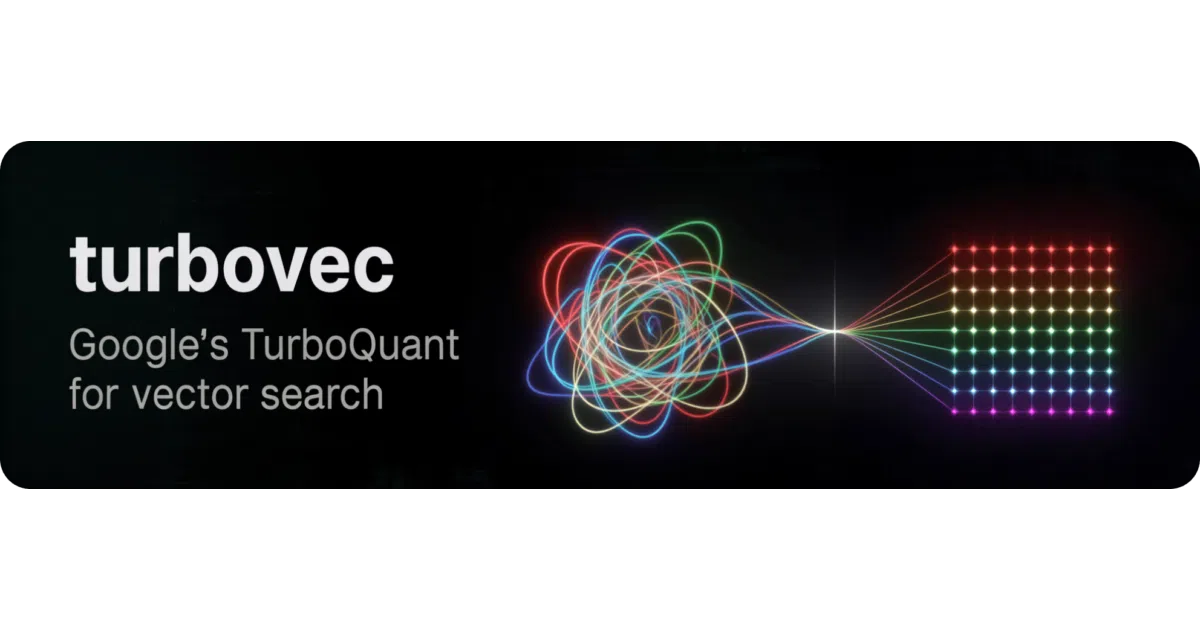
The repo arrived with unusual completeness: PyPI and crates.io packages, framework integrations for LangChain, LlamaIndex, Haystack, and Agno, and benchmark data against FAISS IndexPQFastScan across ARM and x86. Ryan Codrai, the author, did not release a research prototype. He shipped a drop-in replacement for the in-memory vector stores that RAG pipelines already use.
The Core Insight: Data-Oblivious Quantization
Most production vector compression relies on Product Quantization (PQ). The mechanics are well-understood: split each vector into subspaces, run k-means clustering on each subspace to build codebooks of centroids, then encode each segment as the index of its nearest centroid. A 128-dimensional vector might shrink from 512 bytes to 8 bytes — a 64× reduction in the textbook case. The catch is the training phase. You need a representative sample, you need to run k-means++, and if your corpus drifts or grows, you may need to retrain and rebuild the entire index. PQ is data-dependent by design.
TurboQuant takes a different path. It is data-oblivious: no codebook training, no passes over the data, no separate train phase. The insight comes from a geometric property of high-dimensional spaces. After normalizing vectors to unit length and applying a fixed random orthogonal rotation, every coordinate independently follows a Beta distribution that converges to Gaussian N(0, 1/d) in high dimensions. The rotation makes the distribution predictable regardless of the input data. Since the distribution is known analytically, the optimal quantization buckets can be precomputed from the math alone using the Lloyd-Max algorithm. No data required.
This is not merely a theoretical convenience. It removes an entire operational category from vector search deployments. There is no sampling strategy, no train-test split for codebook construction, no midnight retraining job when the embedding model changes. Vectors arrive, they are rotated and quantized immediately, they are searchable. The index grows without rebuilds.
The Implementation: Rust, SIMD, and a Borrowed Correction
turbovec implements this pipeline with careful engineering. The core is Rust with hand-written SIMD kernels: NEON on ARM, AVX-512BW on modern x86 with an AVX2 fallback gated at runtime via is_x86_feature_detected!. The scoring uses nibble-split lookup tables — a layout borrowed from FAISS’s FastScan approach — to maximize throughput. The x86_64 builds target x86-64-v3 (AVX2 baseline, Haswell 2013 and newer), so the crate runs on broadly available hardware, accelerating only where available.
The quantization pipeline has five steps. First, normalization: strip the vector length, store it as a single float, leaving a unit direction on the hypersphere. Second, random rotation by a fixed orthogonal matrix. Third, per-coordinate calibration in the TQ+ variant: fit shift and scale parameters during the first add call, mapping each coordinate’s empirical 5/95% quantiles onto the canonical Beta marginal. This calibration is frozen afterward — a one-time adjustment for the asymptotic approximation. Fourth, Lloyd-Max scalar quantization into 4 or 16 buckets for 2-bit or 4-bit width. Fifth, bit-packing into bytes. A 1536-dimensional OpenAI embedding collapses from 6,144 bytes to 384 bytes at 2-bit — the advertised 16× compression.
The sixth step is a correction borrowed from elsewhere. Scalar quantization systematically underestimates inner products; the reconstructed unit direction is shorter than the original. turbovec adapts the length-renormalization technique from RaBitQ, a SIGMOD 2024 paper on randomized quantization with theoretical error bounds. At encode time, it computes the inner product of the rotated unit vector with its own centroid reconstruction, stores the ratio ||v|| / ⟨u, x̂⟩, and multiplies the per-candidate score by this scalar before heap insertion. The cost is one extra dot product per vector at ingest — sub-second for a million vectors at d=1536. The benefit is an unbiased estimator at zero search-time overhead and zero extra storage.
The Numbers: Memory, Speed, and Recall Tradeoffs
The benchmarks are methodical: 100K vectors, 1,000 queries, k=64, median of five runs. On ARM (Apple M3 Max), turbovec beats FAISS IndexPQFastScan by 12–20% across every configuration. On x86 (Intel Xeon Platinum 8481C, Sapphire Rapids), it wins every 4-bit config by 1–6% and runs within ~1% on 2-bit single-threaded. The only losses are two specific cases: 2-bit multi-threaded at d=1536 and d=3072, where FAISS’s AVX-512 VBMI path edges ahead by 2–4% because turbovec’s inner accumulate loop is too short for unrolling amortization to pay off.
Recall comparisons use FAISS IndexPQ (LUT256, nbits=8, float32 LUT) — a stronger baseline than the custom u8-LUT PQ in the original TurboQuant paper, because FAISS employs higher-precision lookup tables at scoring time and k-means++ for codebook training. On OpenAI embeddings at d=1536 and d=3072, TurboQuant and FAISS are within 0–1 point at R@1 across 2-bit and 4-bit, both converging to 1.0 by k=4–8. GloVe at d=200 is the harder regime: at low dimension, the asymptotic Beta assumption is looser. TurboQuant trails FAISS by 3–6 points at R@1 on GloVe, closing by k≈16–32. The TQ+ calibration recovers up to 1.4 percentage points at @1 on the most drifted cells.
The Lloyd-Max codebook achieves distortion within approximately 2.7× of the Shannon lower bound — the information-theoretic limit on lossy compression. The length-renormalization step removes the residual bias that the Lloyd-Max codebook introduces on the inner-product estimator itself.
The API Design: Local-First, Filter-Native
turbovec exposes two index types. TurboQuantIndex is the simple case: add vectors, search, persist to disk. IdMapIndex adds stable external uint64 IDs with O(1) deletion — useful for document stores where vectors are updated or removed. Both support filtered search via allowlist: pass an array of allowed IDs or a slot bitmask, and the SIMD kernel honors it at 32-vector block granularity. Blocks with no allowed slots short-circuit before any lookup table or scoring work; non-allowed slots inside scored blocks drop at heap insertion. The output length is min(k, len(allowed)) — no padded fallbacks, no over-fetching, no recall penalty for selective filters.
This is architecturally significant for hybrid retrieval. A common RAG pattern runs a cheap first stage — BM25, SQL predicate, time window — to narrow candidates, then reranks with dense vectors. Most vector databases execute the dense search over the full index and filter afterward, or require awkward workarounds. turbovec’s kernel-level filtering means the SIMD cost scales with the candidate set size, not the corpus size. For selective allowlists, most of the index is never touched.
The framework integrations follow the same philosophy: same public surface, same persistence semantics, swap the import. LangChain’s InMemoryVectorStore, LlamaIndex’s SimpleVectorStore, Haystack’s InMemoryDocumentStore, Agno’s LanceDb — each has a turbovec replacement. The pitch is not a new paradigm but a faster, smaller drop-in.
Position in the Landscape
Vector search infrastructure has stratified. At one extreme, managed services (Pinecone, Weaviate Cloud, pgvector with hosted Postgres) handle scale and operations for a fee. At the other, FAISS remains the open-source workhorse — fast, flexible, and research-backed, but C++-native with Python wrappers that show their seams. Between them, a wave of Rust-based projects has emerged: not because Rust is intrinsically faster, but because it offers memory safety without GC pauses, and increasingly mature Python binding tooling via PyO3 and maturin.
turbovec sits in this Rust wave but with a specific differentiation. It is not a database; it is an index. It does not handle metadata, hybrid scoring, or distributed sharding. It does one thing — compress and search vectors — and removes the operational burden of training that has made PQ a last resort rather than a default. The comparison to fast_vector_similarity, another Rust-based vector tool with Python bindings, is instructive: that project focuses on statistical similarity measures (Spearman, Kendall, Hoeffding’s D) with bootstrapping, not on approximate nearest neighbor search at scale. turbovec is narrower and deeper.
The broader context is a shift toward local-first AI infrastructure. Embedding models run on laptops. RAG pipelines execute in air-gapped environments. The default assumption that vector search implies a network call to a managed service is being questioned. turbovec’s marketing leans into this: “Pure local. No managed service, no data leaving your machine or VPC.” The technical capability — 4 GB instead of 31 GB — makes this practical for corpora that previously required cloud infrastructure.
Limits and Open Questions
The GloVe results expose a real limitation. Low-dimensional, non-Gaussian embeddings — word vectors, some sentence encoders — do not fit the high-dimensional asymptotic assumptions as cleanly. TQ+ calibration helps but does not fully close the gap. For applications using these embedding types, FAISS’s data-dependent k-means codebooks still win on recall.
The speed wins on ARM are consistent and meaningful; the x86 results are more mixed, with turbovec trading blows depending on bit width and threading. The 2-bit MT losses suggest that FAISS’s longer optimization history on Intel-specific paths still matters for some configurations. turbovec is newer; its kernels may improve, or FAISS may adopt similar techniques.
The framework integrations are convenient but shallow. They replace in-memory stores, not persistent or distributed ones. For production RAG at multi-million-document scale, you still need a document store, a metadata index, and likely a tiered architecture. turbovec is a component, not a platform.
The theoretical appeal of data-oblivious quantization is clear. The practical question is whether the operational simplification outweighs the recall compromises on non-standard embeddings. For OpenAI-style 1536-dim and 3072-dim vectors, the answer appears to be yes. For the long tail of embedding models, the evaluation is still open.
Sources
- RaBitQ: Quantizing High-Dimensional Vectors with a Theoretical ...
- Dicklesworthstone/fast_vector_similarity: High-performance vector ...
- Google just shrunk 31GB of AI memory down to 4GB. The tool is ...
- Approximate Nearest Neighbor Search by Residual Vector ... - PMC
- I built Embex: A Universal Vector Database ORM with a Rust core for ...
- Meet Turbovec: A Rust Vector Index with Python Bindings, and Built ...
- Product Quantization for Similarity Search | Towards Data Science
- Taking the long road (Part 1): bindings for a vector similarity search ...
- TurboVec is a new open-source vector index built on Google ...
- Local Deep Learning Quantization for Approximate Nearest ...
- Show HN: Fast vector similarity using Rust and Python | Hacker News
- turbovec for RAG: A Practical Guide to Faster, Smaller Vector Search