PaddlePaddle/PaddleOCR · 11 Jun 2026 · Feature
The 0.9B Model Eating Google's Lunch in Document AI

Andrei Popescu
Staff Writer
Baidu's PaddleOCR has quietly become the default open-source engine for turning messy documents into LLM-ready structured data, with a vision-language model so small it runs on modest hardware yet outperforms proprietary alternatives on industry benchmarks.
PaddlePaddle/PaddleOCR
★91.7k stars Velocity · 7d +48 ★/day ↘cooling
star history
The Hinge Moment: When OCR Became RAG Infrastructure
Optical character recognition spent decades as a back-office utility—scanned invoices, digitized archives, the occasional license plate reader. The technology’s lineage traces to Emanuel Goldberg’s early-20th-century character-reading machine and Yann LeCun’s foundational CNN work on handwritten digits in the late 1980s. For most of its history, OCR was plumbing: necessary, invisible, and increasingly commoditized by cloud APIs from Google, Microsoft, and Amazon.
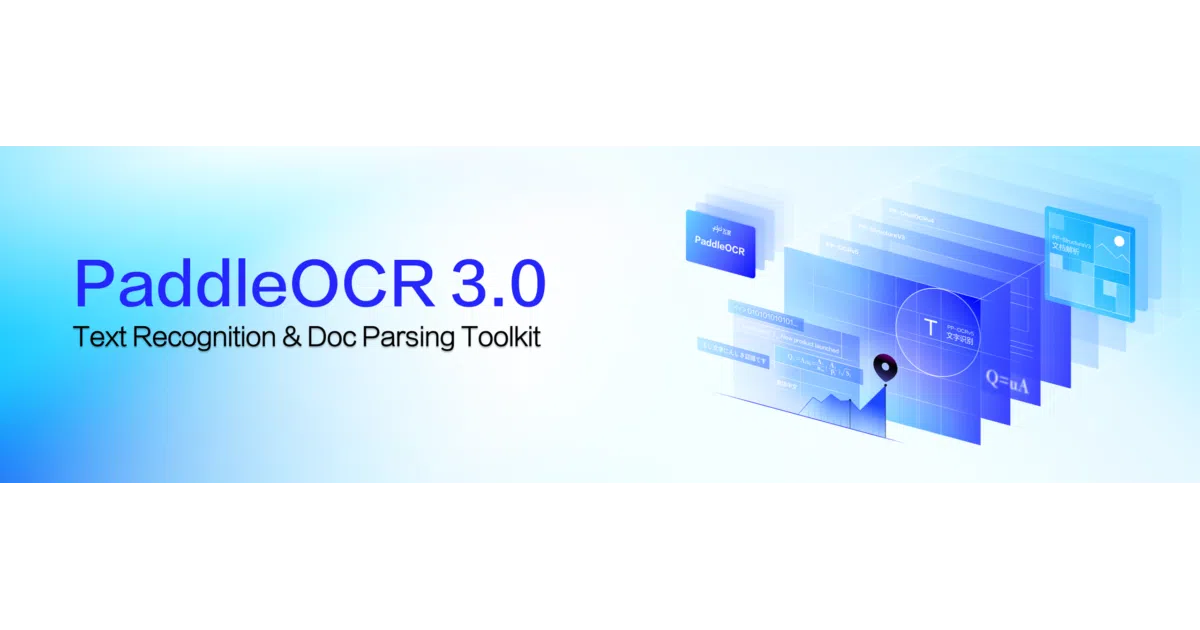
The current attention spike around PaddleOCR reflects a category shift. Large language models and retrieval-augmented generation systems need clean, structured input. A PDF full of tables, formulas, and irregular layouts is not merely “unreadable” to an LLM—it actively degrades retrieval quality. PaddleOCR’s maintainers at Baidu recognized this inflection early, repositioning the project from a conventional OCR toolkit into what they now term an “LLM-ready data” pipeline. The repository’s 70,000+ GitHub stars and adoption by projects like Dify, RAGFlow, and Cherry Studio suggest the market agrees with this framing.
The timing is not accidental. Enterprise document processing has evolved from simple text extraction toward “intelligent document processing” platforms that combine OCR, classification, and workflow automation. Google’s Document AI and Cloud Vision API represent the proprietary end of this spectrum, offering 200+ language support and tight cloud integration. PaddleOCR occupies a different niche: open-source, hardware-agnostic, and increasingly optimized for the specific pathology of documents fed into AI systems.
The Technical Wager: Small Models, Specific VLM Architecture
PaddleOCR’s recent momentum centers on a counterintuitive bet: that a 0.9 billion parameter vision-language model can outperform larger generalist alternatives on document-specific tasks. The PaddleOCR-VL-1.6 release claims 96.3% accuracy on OmniDocBench v1.6, a benchmark for page-level document parsing. The architecture pairs a NaViT-style dynamic resolution visual encoder with Baidu’s ERNIE-4.5-0.3B language model. This is not a scaled-down GPT-4V or Gemini; it is a purpose-built narrow model for a narrow problem.
The design choices reveal the engineering philosophy. Dynamic resolution encoding avoids the fixed-grid distortions that plague document images with mixed text sizes, wide tables, or marginal annotations. The ERNIE backbone, already trained on Chinese and multilingual corpora, provides linguistic priors without the overhead of a generalist conversational model. The result, according to Baidu’s technical reports, is competitive performance against “top-tier VLMs” with substantially faster inference and lower resource consumption.
This matters practically. Document parsing at scale—think millions of pages in a legal discovery process or a national archive digitization—cannot afford GPU-cluster inference costs per page. PaddleOCR-VL’s efficiency claims, if borne out in production, represent a genuine economic alternative to cloud API pricing. The model runs on CPU, GPU, Baidu’s Kunlunxin XPU, and other AI accelerators, with C++ deployments matching Python accuracy on both Linux and Windows.
The PP-OCRv5 recognition pipeline complements this VLM with a more traditional two-stage approach: detection followed by recognition, optimized for scene text and multilingual documents. At 2 million parameters, it handles 109 languages including scripts like Cyrillic, Arabic, Devanagari, Tibetan, and Bengali. The accuracy improvements over previous generations—13% overall, with some language-specific models gaining over 40%—suggest the narrow-model strategy extends beyond the VLM flagship.
The Ecosystem Play: From Model to Infrastructure
Technical merit alone does not explain PaddleOCR’s adoption velocity. The project has assembled an integration surface that treats document parsing as infrastructure rather than feature. PP-StructureV3 converts complex PDFs and images into Markdown or JSON with coordinate-level granularity for table cells and text blocks. PaddleOCR.js runs PP-OCRv5 directly in browsers. DOCX export allows parsed results to round-trip into Microsoft Word for human verification.
The downstream project list reads like a census of current AI tooling: Dify for agentic workflows, RAGFlow for retrieval systems, Pathway for stream processing, Cherry Studio for desktop LLM clients, Microsoft’s OmniParser for GUI automation, and Haystack for enterprise search. NVIDIA hosts PaddleOCR models on its NIM platform. This is not academic usage; it is production dependency by projects with their own user bases and commercial pressures.
Baidu’s strategic positioning here mirrors Google’s approach with Document AI but executed through open-source distribution. Where Google offers “Enterprise Document OCR” as a cloud service with configurable features like rotation correction, image quality scoring, and math formula extraction, PaddleOCR provides comparable capabilities as downloadable models with optional self-hosted serving. The trade-off is operational complexity against vendor lock-in and per-page pricing.
The Benchmark Reality and Its Limits
The OmniDocBench claims deserve scrutiny. Baidu reports that PaddleOCR-VL-1.6 “leads both open-source and proprietary solutions” on text, formula, and table recognition, with specific mention of outperforming “top-tier general large models.” The 1.5 version introduced Real5-OmniDocBench to test robustness against physical distortions—scanning artifacts, skew, warping, screen photography, and illumination variation—where document images often fail in production.
What remains unclear is the comparison baseline. “Proprietary solutions” likely includes Google’s Document AI and perhaps Azure’s Form Recognizer, but the specific versions and configurations are unspecified. The “top-tier VLMs” category presumably encompasses GPT-4V, Gemini Pro Vision, and Claude 3 Opus, though these models are not primarily designed for document parsing and may not be fine-tuned on comparable training data. A 0.9B model outperforming 100B+ generalist models on a specialized benchmark is plausible; it is also the expected outcome of appropriate specialization. Whether this translates to superior real-world performance across diverse document types requires independent validation that the README citations do not provide.
The multilingual claims similarly need context. PP-OCRv5’s 109 languages exceeds Google’s advertised 200+ for Document AI, but language count is a misleading metric. Performance varies enormously by script complexity, training data availability, and document quality. The Tibetan and Bengali additions in recent releases suggest genuine expansion, but “support” does not guarantee accuracy parity with high-resource languages like English or Chinese.
The Tension: Open Source in a Proprietary AI Landscape
PaddleOCR’s development model carries inherent friction. Baidu maintains the project as part of its PaddlePaddle deep learning framework, which competes with PyTorch and TensorFlow. The ERNIE language model at PaddleOCR-VL’s core is Baidu proprietary technology, not an open-weight release like Llama or Mistral. Users can download and run the model; they cannot inspect, modify, or independently train its full architecture without Baidu’s infrastructure.
This creates a hybrid status: open-source tooling around partially open models. The recent addition of llama.cpp inference support and Transformers backend compatibility (version 3.5.0) broadens deployment options, but the model weights remain Baidu’s to update, deprecate, or restrict. For enterprises building document pipelines on PaddleOCR, this is a manageable risk—comparable to dependence on OpenAI’s API or Google’s cloud services—but it is not the same risk profile as fully open alternatives.
The competitive landscape reflects this ambiguity. Google’s Document AI offers tighter integration with Workspace, Cloud Storage, and BigQuery, plus enterprise features like AutoML custom model training without machine learning expertise. ABBYY, Tungsten Automation, and Rossum occupy the traditional enterprise IDP space with workflow automation and ERP integration. PaddleOCR’s differentiation is technical performance per dollar and hardware flexibility, not feature breadth or enterprise process management.
Where the Project Is Heading
The version 3.6.0 release (May 2026) and its predecessors reveal a clear trajectory: deeper integration with the Hugging Face ecosystem, broader inference backend support, and progressive expansion of document element types. Ancient document recognition, seal detection, chart understanding, and cross-page table merging address real pain points in production document processing that generic OCR ignores.
The “Data Engine” concept—using PaddleOCR to build fine-tuning datasets for larger language models—positions the project within AI’s broader data infrastructure. If document parsing becomes a standard preprocessing stage for enterprise LLM deployment, PaddleOCR’s early positioning as “LLM-ready” may yield durable adoption even as model capabilities evolve.
The unresolved question is sustainability. Baidu’s investment in PaddleOCR serves PaddlePaddle ecosystem growth and cloud service adoption. Whether this aligns with community needs over a five-year horizon depends on Baidu’s strategic priorities and the project’s ability to attract independent contributors. The 400+ contributor visualization in the README suggests healthy community scale, but core model development remains centralized.
For technically literate readers evaluating document AI options, PaddleOCR represents a specific proposition: state-of-the-art accuracy on specialized benchmarks, hardware flexibility from edge to cloud, and open-source integration at the cost of partial model opacity and self-hosted operational burden. It is not a revolutionary technology; it is a well-executed specialization at a moment when document-to-LLM pipelines have become critical infrastructure. The hype is justified by the use-case fit, not by transcendence of OCR’s fundamental constraints.
Sources
- What Is OCR (Optical Character Recognition) Technology? - Forbes
- Enterprise Document OCR | Document AI
- PaddlePaddle/PaddleOCR-VL-1.5 - Hugging Face
- advancements in optical character recognition systems for real-time ...
- OCR With Google AI | Google Cloud
- PaddleOCR-VL, is better than private models : r/LocalLLaMA - Reddit
- Optical Character Recognition Trends & Applications - Jumio
- Any enterprise OCR software that can handle complex documents?
- paddleocr Model by Baidu - Nvidia NIM
- Optical Character Recognition Market Size Report, 2030
- Best OCR Software for Enterprises 2026 - Doxis
- PaddleOCR: The latest lightweight OCR system | by David Cochard