Kilo-Org/kilocode · 23 Jun 2026 · Feature
Kilo Code Bets on Ubiquity as Coding Agents Converge

Tyler Brennan
Staff Writer
Kilo Code exists to turn every developer surface—IDE, terminal, chat, and cloud—into a single, model-agnostic agentic workspace.
Kilo-Org/kilocode
★27.5k stars Velocity · 7d +10 ★/day ↗accelerating
star history
The Hype and the Hard Fork
Kilo Code did not emerge from a vacuum. Its CLI is a fork of OpenCode, a lineage the project discloses in its FAQ with the same casual transparency most startups reserve for their origin myths. That lineage has been recast into something larger: an “all-in-one agentic engineering platform” that claims over three million users and more than forty trillion tokens processed. The VS Code extension alone has accumulated 1.2 million installs, and the project lists developers at Meta, Amazon, Airbnb, PayPal, Square, and Red Hat among its users. Whether those names represent enterprise deployments or individual engineers experimenting on side projects is ambiguous, but the social proof is clearly part of the pitch.
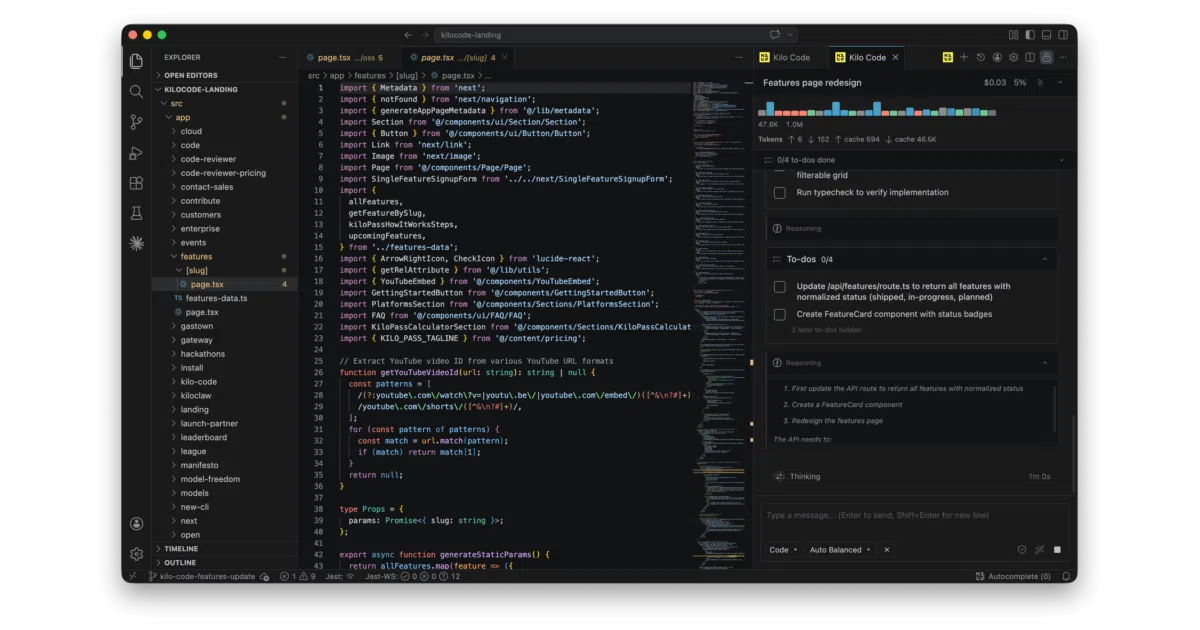
The marketing is tactical and opportunistic. Kilo publishes a migration guide for users leaving Roo Code and has explicitly positioned itself as a refuge for developers affected by Augment’s IDE extension changes. It claims the title of #1 Open Source Product of the Month—though the awarding body goes unnamed—and even its development process broadcasts velocity: snapshot builds embed the current Git commit SHA and the developer’s configured username directly into the version string, a detail that signals either radical transparency or a build pipeline that has not yet learned to hide its internals. The name “Kilo” implies scale, and the project leans into that promise with a gateway offering five hundred-plus models, including headline names like GPT-5.5, Claude Opus 4.7, and Gemini 3.1 Pro Preview, with transparent pricing that matches provider rates exactly and an explicit prohibition against silent model switching. The README even promises that Kilo “checks its own work,” a claim that sounds reassuring until one considers what the agent is checking itself against.
The Convergence Problem
Kilo Code is launching into a market that has already agreed on what an AI coding agent should look like. By early 2026, the ecosystem had converged on a shared architecture: repo memory files for persistent project context, direct tool use for Git and shells and browsers, sub-agent orchestration for planning and testing, and long-running execution that lets agents work for minutes or hours without human hand-holding. The field has sorted itself into three archetypes. CLI-first agents operate in terminals to read repositories, execute shell commands, and run tests, offering maximum flexibility. IDE-native agents embed directly into editors to edit multiple files and navigate symbols, optimizing for developer flow. Cloud engineering agents run in persistent cloud environments, taking GitHub issues and opening pull requests autonomously.
Kilo refuses to pick one lane. It offers a VS Code extension and a JetBrains plugin for the IDE crowd, a CLI for terminal purists, and cloud and Slack integrations for persistent, always-on operation. It even ships KiloClaw, a hosted, always-on agent that lives outside the IDE entirely, executing shell commands, browser control, scheduled tasks, and cron jobs via Telegram, Discord, or Slack with auto-restart and monitoring. The strategy is ubiquity: be the agent that follows the developer across every surface, rather than the one that owns a single context.
This breadth is either prescient or scattershot. Industry surveys suggest roughly eighty-five percent of developers were regularly using AI coding tools by the end of 2025, and the market has shifted decisively from autocomplete to autonomous agents. Analyst roundups now evaluate tools across five dimensions: cost and token efficiency, real productivity impact, code quality and hallucinations, repository understanding, and privacy. In that framework, Kilo is listed as an emerging tool alongside AWS Kiro and Zencoder, not yet ranked alongside the established defaults: Cursor as the polished IDE for everyday shipping, Claude Code as the strongest reasoning engine, GitHub Copilot as the pragmatic corporate choice. Kilo’s response is to outflank them on distribution, hoping that being everywhere compensates for not yet being the default anywhere.
Modes, Models, and the MCP Bazaar
Technically, Kilo differentiates through modularity and model agnosticism. Users can switch between specialized agent modes—Architect for planning, Coder for implementation, Debugger for troubleshooting—or build custom modes. Auto Model routing classifies sessions across Efficient, Frontier, Balanced, and Free tiers, ostensibly optimizing spend without the user manually swapping API keys. The platform also hosts an integrated MCP Server Marketplace, letting users extend the agent’s capabilities by plugging in external servers, a feature that aligns neatly with the industry-wide shift toward tool-use primitives.
These features map onto the 2026 consensus. Repo memory, tool use, and sub-agent orchestration are now table stakes. Kilo’s addition is the “all-in-one” packaging: inline autocomplete, natural-language generation, terminal execution, browser automation, and refactoring inside a single open-source codebase. The README advertises API keys as optional, which implies a freemium gateway layer—Kilo Gateway—that brokers access to those five hundred models. The project promises full prompt and context-window visibility, a subtle jab at competitors who hide the prompt soup behind proprietary abstractions. It also supports bring-your-own-keys and local model deployment, gestures toward privacy-conscious users who do not want proprietary gateways handling their proprietary code.
The Autonomy Ceiling
For all the platform’s breadth, the hard limits of agentic coding remain unchanged. Experiments by Thoughtworks engineers to push AI autonomy to its edge—using Claude-Sonnet models to build Spring Boot applications end-to-end—revealed a familiar pattern of overeagerness. Agents generated unrequested features, filled requirement gaps with shifting assumptions, applied brute-force fixes, and occasionally declared victory while tests still failed. The result was a “game of whac-a-mole” with static analysis issues, reinforcing the conclusion that human supervision remains non-negotiable. An experienced developer, the authors noted, could write the same application in one to two hours with a capable IDE.
Kilo Code acknowledges this tension indirectly. Its CLI offers an autonomous mode for CI/CD pipelines that disables all permission prompts and allows the agent to execute any action without confirmation, but the documentation immediately warns that this should only be used in trusted environments. That warning is a legal and technical fig leaf: the tool can run shell commands and modify code unsupervised, but the project knows that unsupervised agents are still agents that hallucinate, iterate blindly, and break builds.
Enterprise adoption research underscores the risk. Organizations treating AI coding as a drop-in technology rather than a process challenge tend to suffer code quality issues, security vulnerabilities, and developer resistance. AI amplifies existing practices—improving quality where review processes are strong and degrading it where they are weak. The research identifies three core tensions: maintaining code quality while accelerating speed, preserving security and privacy when using external models, and enhancing productivity without disrupting workflows. Public models trained on public repositories may reproduce vulnerable patterns or expose proprietary data through external server processing, a risk that makes Kilo’s local-deployment and BYOK options look less like features and more like necessities. Governance, in this context, matters more than model count.
The Outlook: Surface Area vs. Depth
Kilo Code’s trajectory suggests a bet that the winning agent will be the one with the most touchpoints, not the one with the deepest reasoning. Recent additions—Next-Edit powered by Inception With Mercury Edit 2, integrated Terminal Bench scores for model evaluation, and Kilo for GitHub—extend the platform’s reach without necessarily deepening its intelligence. The project is building a horizontal layer across the entire development lifecycle, from IDE autocomplete to cloud CI/CD to chatbot sidekick.
Whether that layer can maintain coherence is the open question. The 2026 agent landscape rewards specialization: Cursor for daily shipping, Claude Code for complex reasoning, Aider for serious refactoring. Kilo’s promise is to do all of it, everywhere, for everyone. In a market converging on shared primitives, differentiation through surface area is expensive. Every new integration—Slack, JetBrains, Telegram, GitHub—carries maintenance overhead, and every additional model in the gateway adds latency and cost complexity.
The project’s open-source licensing—MIT in the repository, Apache 2.0 on the VS Code Marketplace—hints at rapid, perhaps messy, growth. Its active Discord community suggests it is moving fast. But speed is not strategy. If the coding agent market truly consolidates around a common architecture, Kilo Code’s advantage will not be its models or its modes, but its ability to be the ambient agent that simply never leaves the developer’s side. That is a product thesis, not a technical one. And in a field where even the best models still need a human to clean up after them, ubiquity may prove less valuable than judgment.
Sources
- Kilo Code
- The State of AI Coding Agents (2026): From Pair Programming to ...
- AI code generation: Best practices for enterprise adoption in 2025 - DX
- Autonomous Coding Agents: Beyond Developer Productivity - C3 AI
- How far can we push AI autonomy in code generation? - Martin Fowler
- Kilo Code: AI Coding Agent, Copilot, and Autocomplete
- Whats the current best autonomous coding agent? : r/singularity
- Best AI Coding Agents for 2026: Real-World Developer Reviews
- Read Customer Service Reviews of kilocode.ai - Trustpilot
- What are AI agents? - GitHub
- AI Code Generation Explained: A Developer's Guide - GitLab
- Just tried Kilo Code - what are we all going to do for work!? (kind of ...