Fei2411/DS-Bot · 20 Nov 2026 · Feature
The Multi-Agent Stack, Shrunk to Fit One Person's Laptop

Patrick Donovan
Staff Writer
DS Bot takes the agent-team idea enterprises are paying consultants to explain and ships it as a local chat app where you just talk to your chief bot.
Fei2411/DS-Bot
★8.6k stars Velocity · 7d +927 ★/day ↗accelerating
star history
The multi-agent conversation has gotten loud. Framework vendors publish guides ranking themselves against each other — LangChain’s survey of agent frameworks evaluates seven contenders on prototyping speed, production reliability, and observability, while IBM’s framework selection guide walks businesses through five evaluation factors including complexity, data privacy, and scalability. MIT Sloan’s explainer on agentic AI quotes Nvidia’s CEO calling enterprise agents a multi-trillion-dollar opportunity. Google Cloud’s catalog of real-world use cases identifies a shift from passive assistants to “autonomous agentic teams orchestrating workflows” as a top trend across 1,302 documented deployments.
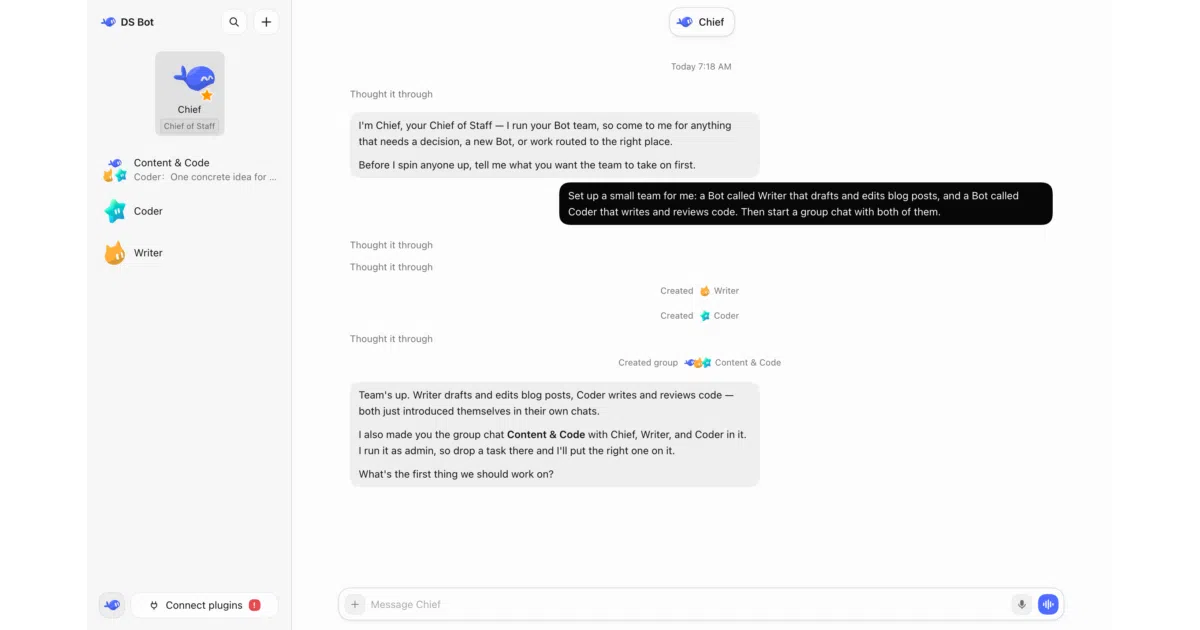
Against that backdrop, DS Bot is almost comically small in ambition and quietly radical in form. It is not a framework. It is not aimed at a platform team. It is a plugin for DeepSeek Harness — DSH, an open-source agent harness — that turns your harness into a roster of named bots you chat with, group into team conversations, and delegate work to. The entire orchestration layer that CrewAI and LangGraph expose as graphs, state machines, and durable execution is, in DS Bot, a chat window with a bot called Chief in it.
One window, one chief, a cast of specialists
The core move is reframing. Every bot in DS Bot is a DSH session wearing a name tag — it uses the DSH tools and models, keeps its own model selection, its own memory, and (in later versions) its own working folder and permission preset. You talk to one bot in one window and don’t manage the context behind it. The bot remembers what you like and carries it into later work; you can inspect and edit that memory on the bot’s details page, or just tell the bot to change it.
The main bot is the interesting design decision. Chief ships pre-created, holds elevated rights, and manages the other bots and group chats. The README’s setup advice is a single sentence: set everything up by talking to a bot. Have a question? Ask the main bot. This is the entire user manual, and it is a genuine stance — the project bets that natural language is a sufficient control surface for agent orchestration, which is precisely the bet the framework vendors keep hedging on with visual editors and YAML.
Group chats are where the multi-agent story lands. Each group has an admin bot that answers by default and calls in other specialists as needed; you can @-mention a bot directly, and bots can hand work to each other. Groups carry their own memory and working folders, invisible to outside bots. Later versions add “Goals” — the admin aligns with you on completion criteria, splits work into stages, and checks each stage — which is, functionally, a lightweight plan-execute-verify loop implemented as conversation. The README is candid about the cost: group chats “clearly cost more” tokens, which is why the admin-mediated default exists rather than every bot answering every message.
The boring part is the product
What makes DS Bot more than a cute skin over DSH is the accumulation of small, unglamorous mechanics. A /side command lets you ask a side question without derailing a bot mid-task. Bots can be steered while working. Scheduled tasks run without you. Usage tracking breaks token consumption down by time, bot, and model — the kind of accounting that matters once you have a dozen agents spending your quota in parallel. All data stays on your own machine, in folders under the DSH home directory, and uninstalling the plugin doesn’t delete it.
The memory format is plain Markdown, an idea the acknowledgments credit to AgentMemoryRepo. That choice is easy to overlook and hard to overstate: bot memory you can read with a text editor, diff with git, and edit by hand is a different category of thing from memory locked in a vector store. It is auditable by construction.
An acknowledgments section that doubles as a design document
The most telling part of the README is the credits. DS Bot names eight-plus projects it learned from and is explicit that it contains none of their code: checkpoint formatting from OpenAI Codex, group chat rounds and @-mention relays from OpenMausBot, one-session-per-member-per-group and context-carrying handoffs from Hermes Agent, chat-condensing timing from OpenCode, goose, pi, and Gemini CLI, full-text chat search via SQLite from obelisk. That is a curated lineage of hard-won design decisions from production agent tools, assembled into a consumer-shaped product. It reads less like courtesy and more like the actual architecture doc — the interesting engineering here is knowing which ideas to lift, and the list is well-chosen.
Where it sits in the field
The framework landscape DS Bot ignores is substantial. The GetStream multi-agent framework roundup covers Agno, OpenAI Swarm, LangGraph, Autogen, CrewAI, and others, all pitched at developers wiring agents into applications. Google Cloud’s multi-agent systems primer frames MAS as distributed, protocol-driven architectures with agent communication languages and orchestration layers — hundreds or thousands of agents, message passing, stigmergy. LangChain’s guide draws the line at production readiness: durable execution, state persistence, predictable error handling, the difference between demo frameworks and production ones.
DS Bot answers none of those questions because it isn’t asking them. It is a single-user, single-machine take on the same trend Google Cloud says enterprises are chasing — autonomous agentic teams — with the reliability story outsourced to DSH underneath it and the orchestration story reduced to a chief bot and an admin per group. Whether that reduction is insight or naivety depends on the workload. For a person who wants a writer bot, a coder bot, and a chief to dispatch between them, the graph-based machinery of the big frameworks is overhead with no payoff. For a team building customer-support automation, DS Bot is the wrong tool entirely, and its own positioning doesn’t pretend otherwise.
The project has also spawned an ecosystem fragment: DS-Bot-App, a fork that adds mobile and desktop clients connecting your phone to bots running on your own DSH host, with streaming replies, tool-result approval cards, per-bot MCP servers, and a security model that deliberately does not inherit the host’s mobile authorization or TLS identity when importing a bot team — mobile access starts disabled and must be re-paired. A fork that treats “your agents, reachable from your pocket, without leaking the host’s credentials” as its headline concern is a decent signal about what users actually want from long-lived bots.
Distribution, meanwhile, has outgrown the plugin. The winstall listing shows a standalone desktop app at version 0.3.8, published under Apache-2.0 and available via winget, that bundles its own DSH so no prior installation is needed. From a v0.1 preview plugin to a winget-distributed app with a mobile fork is a fast trajectory for a community project.
The rough edges, honestly labeled
The project is upfront about its limits, which deserves note because the agent space rarely is. The README carries a disclaimer in bold: DS Bot is an independent community project, not an official DeepSeek product, not affiliated or endorsed. The version badges tell the rest — v0.1 preview riding on DSH 0.2.1-alpha.1, which is to say the whole stack is pre-1.0 and the ground underneath it moves.
Two limits matter more than version numbers. First, the isolation between private bots is not a sandbox: separate folders, memory, and history, yes, but shell or network access still reaches the system. Second, the bots run commands and write files when you ask them to, and the README’s advice is simply to check important actions yourself — human-in-the-loop as a documented expectation rather than a guardrail. Group chat token costs are acknowledged but not quantified; no benchmarks, adoption figures, or user counts appear anywhere in the available material, so any claim about real-world traction would be invention.
Outlook
The open question is whether “talk to Chief” scales as a control paradigm. It works while the roster is small and the user is the operator; whether it survives a dozen bots, scheduled tasks, and goals running in parallel is exactly the regime where the framework vendors argue you need durable execution and observability. DS Bot’s bet is that for the single-user case, legibility — Markdown memory, local files, a usage page — substitutes for infrastructure. That bet is unproven. But as a demonstration that the industry’s most hyped architectural pattern can be compressed into something a person runs on their own laptop, with their own model quota, and understands end to end, DS Bot is a more interesting data point than another entry in the framework rankings.
Sources
- Best 5 Frameworks To Build Multi-Agent AI Applications
- Agentic AI, explained
- QingJ01/DS-Bot-App: A team of long-lived bots for DeepSeek Harness ...
- The best AI agent frameworks in 2026
- Real world examples of AI agents - use cases that really matter
- DS Bot Download
- What is a multi-agent system in AI?
- What is multi-agent AI, and how is it useful in business?
- DS-Bot A team of long-lived bots for DeepSe ...
- AI Agent Frameworks: Choosing the Right Foundation for Your Business
- Real-world gen AI use cases from the world's leading organizations
- DS Bot