CopilotKit/OpenBot · 11 Sep 2026 · Feature
OpenBot Treats Agent Governance as Infrastructure, Not an Afterthought

Marcus Reed
Senior Editor
An alpha-grade platform that wraps every browser action, file touch, and MCP call in a policy gateway before the agent ever gets to act.
CopilotKit/OpenBot
★7.1k stars Velocity · 7d +63 ★/day ↘cooling
star history
The browser-agent gold rush is in full swing. Projects like Browser-use have collected more than a hundred thousand stars by letting large language models drive Chromium like a human, and LinkedIn feeds are alight with predictions that agentic browsers such as Operator, Project Mariner, and Dia will redraw how we use the internet. One YouTube promoter has already declared that OpenBot Just CHANGED AI Agents Forever! The excitement is palpable. So is the anxiety. Beneath the hype, enterprise buyers are asking harder questions: how do you prevent an agent from phishing at machine speed, scraping confidential data to a rogue cloud, or hallucinating an irreversible workflow? As one skeptical commenter noted, without runtime governance, efficiency gains become helpdesk tsunamis and compliance violations explode.
That skepticism is why governance frameworks are suddenly in vogue. Microsoft’s cloud adoption guidance now treats AI agents as organizational risks that require a centralized control plane, an agent registry, and enforceable security baselines. Airia’s research argues that traditional AI governance—content filtering and acceptable-use policies—collapses the moment an agent starts chaining tool calls, because risk compounds with each step and the specific actions are no longer predictable from the initial prompt. Agents do not merely respond to prompts; they pursue goals, accumulate state, and invoke tools across APIs, databases, and email systems. A content filter scanning inputs and outputs misses everything that happens when an agent writes to Salesforce or sends a message through Slack. Sweet Security adds that the controls must live where agents execute, evaluating whether each action is expected, permitted, and reversible. The consensus is clear: if agents are going to act, they must do so inside a boundary that decides, records, and can refuse every single action.
OpenBot, an alpha-stage open-source project from CopilotKit, is an attempt to ship that boundary as infrastructure rather than slide-ware. It is not merely a browser agent. It is an agent platform that wraps every browser navigation, file system touch, and MCP server call inside a policy gateway that runs on your own hardware. The README is unapologetically aimed at the security review, and the architecture reads like a direct response to the governance gaps the industry is currently theorizing about.
A Gateway, Not Just a Bot
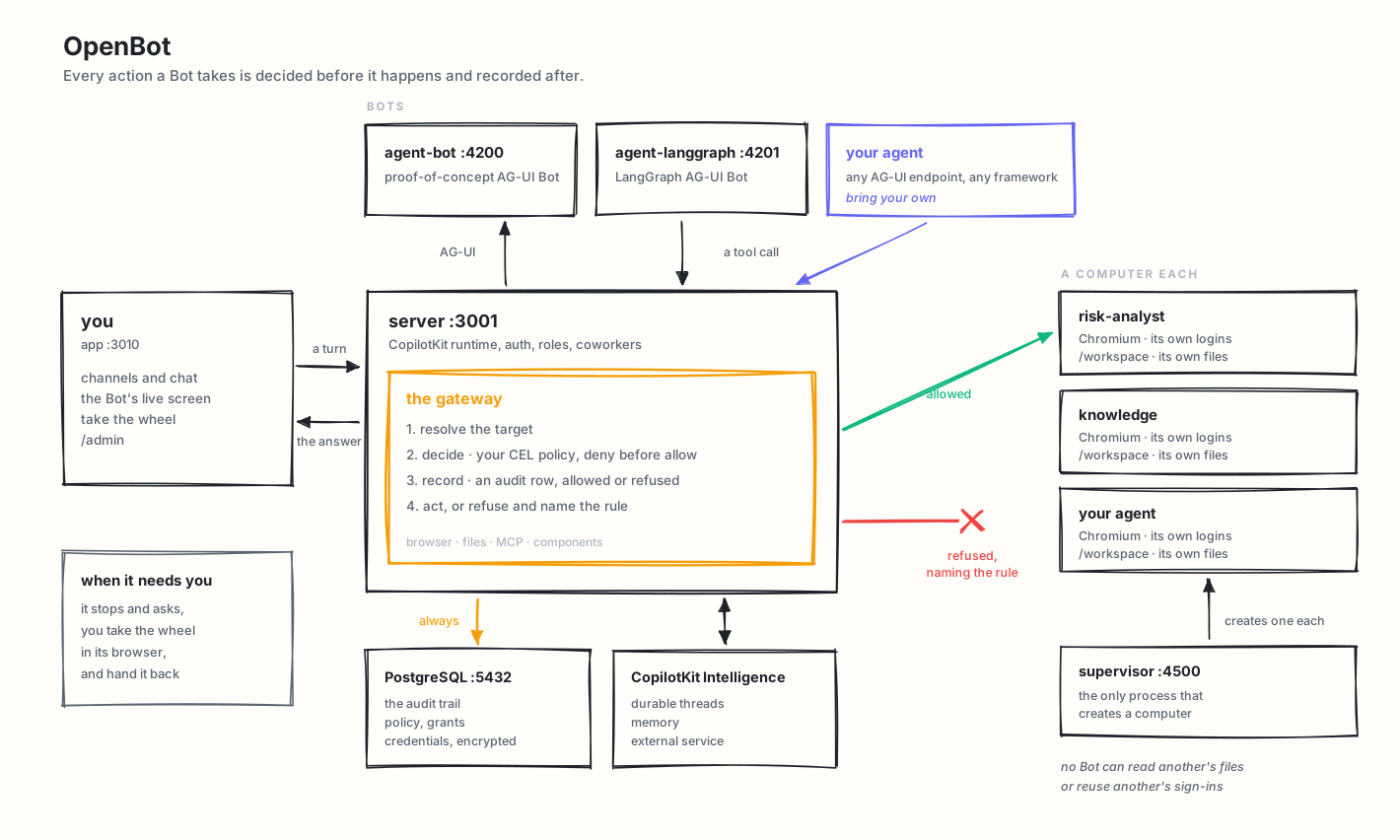
The core technical bet is the gateway. In most browser-agent demos, the model decides to click, and the click happens. In OpenBot, the model decides to click, but the click is merely a request. The server gateway resolves the target from a server-held snapshot, evaluates a CEL policy against attributes such as the tool name, the page URL, the bot identity, the actor, and even DOM element properties, writes an audit row to PostgreSQL, and only then forwards the action to the bot’s dedicated computer. Deny rules are evaluated before allow rules. A missing policy permits nothing. A malformed policy refuses rather than opens. The system is explicitly fail-closed, which is the difference between an agent that can use your tools and an agent you can let near them.
This granularity matters because browser agents are inherently promiscuous. A model with vision capabilities can see a delete button just as easily as a submit button. OpenBot’s policy engine can inspect element properties and page host values, meaning an administrator could write a rule that permits form-filling on internal domains while refusing any navigation toward an external URL, or allows reading from a knowledge base while blocking write operations to the same index. The gateway is the only path in; there is no side channel that lets the bot computer bypass the audit trail.
Each bot gets its own containerized computer—Chromium, a private workspace volume, and an isolated browser profile—managed by a supervisor. The host can optionally run these under gVisor for additional sandboxing. When a bot hits a login wall or a two-factor prompt, it does not guess; it asks for help. A human can take the wheel inside the same chat panel, drive the browser manually, and hand control back. While the human is driving, bot actions are refused rather than queued, and the transcript records the handoff events. Secrets requested during the session are never written to the transcript; only the fact that a secret was requested and its length are logged. Credentials are stored write-only, encrypted at rest with an administrator-supplied key, and never returned by any API.
The platform also extends governance to components and skills. Rather than emitting only prose, bots can return sandboxed React components, but every component call asks the server whether the artifact exists, is published, and is not withheld from that specific bot. Personal and deployment skills are invoked with a slash command, but they are instructions scoped to ownership: a personal skill attaches only to bots its author owns, while deployment skills are admin-owned. Even MCP servers are governed through a curated catalog for tools like Atlassian, Box, Slack, Salesforce, and ServiceNow, with custom servers subjected to URL validation and any unclassified tool treated as a write operation by default.
The AG-UI Bet
Another deliberate choice is AG-UI, the Agent-User Interaction Protocol that CopilotKit wrote and maintains. OpenBot accepts any endpoint that speaks AG-UI, which means agents built with LangGraph, Mastra, CrewAI, Pydantic AI, Google ADK, or plain hand-rolled code all register the same way. The governance rides the protocol, not the framework. In a market where vendors are trying to lock users into agent-building stacks, OpenBot’s neutrality is a strategic hedge. It treats the agent framework as interchangeable plumbing and the interaction and control layer as the actual product. The protocol covers what MCP and A2A do not: how the work becomes something a person can watch, question, and interrupt.
The deployment model is equally pointed. Nothing ships in the box. No model, no bundled LLM, no external telemetry. An administrator brings their own OpenAI, Anthropic, or Google key, which is encrypted at rest and never logged. The data lives in your PostgreSQL instance. Durable threads and memory rely on CopilotKit Intelligence, but the rest of the stack—app, API server, supervisor, bot computers—runs locally. Loopback binding and per-container tokens keep the browser instances from accidentally exposing themselves to the network. The default development mode skips authentication entirely, treating every request as an administrator, but Google OAuth and role-based access can be wired up for production.
Alpha State and Open Questions
All of this is packaged as an MIT-licensed repository with a blunt alpha warning: expect rough edges, expect bugs, expect things to move. And there are real friction points. Setup requires Bun, Docker, and a CopilotKit Intelligence project with a valid license token. The dependency on CopilotKit Intelligence for memory and thread durability means the “runs on your machine” claim comes with a tether. The README does not clarify pricing or whether Intelligence can be self-hosted, leaving a strategic ambiguity around long-term vendor lock-in. Policy evaluation latency under heavy concurrency is also unexplored territory; a fail-closed gateway is only useful if it does not throttle the agent into uselessness. The example bots—General Assistant, Knowledge, Risk Analyst—are thin configuration files rather than sophisticated agents, so much of the intelligence still depends on whatever model and framework you bring.
Still, the project arrives at an inflection point where agent capabilities are decisively outpacing enterprise readiness. The browser-agent wave—embodied by the star-count of Browser-use and the marketing thunder of Operator—has proven that models can drive GUIs. What it has not proven is that enterprises can let them. Boomi’s framework warns of agent sprawl and shadow deployments; OpenBot’s answer is a single tenant per deployment, an explicit agent registry in the UI, and an audit trail that names the rule behind every refusal. OpenBot’s thesis is that governance cannot be retrofitted after the agents are already inside the firewall. It must be the substrate: the gateway, the audit trail, the per-bot sandbox, and the human override, all shipped as infrastructure.
The Real Test
Whether OpenBot becomes the reference architecture for self-hosted agent fleets or merely a prescient footnote depends on whether it can mature faster than the incidents it is trying to prevent. The alpha label is honest, but the market may not wait. If the CopilotKit team can harden the CEL engine, make the Intelligence dependency optional, and prove that fail-closed policy enforcement can scale without asphyxiating throughput, they will have built something genuinely rare: an open-source control plane that makes autonomous coworkers actually employable. If they cannot, the repository will stand as a reminder that the most important feature of an AI agent is the off-switch you can find—and the audit log that proves someone used it.
Sources
- What is AI Agent Governance? A Framework for Keeping ...
- Agents that use the browser. · GitHub
- OpenBot
- Govern and secure AI agents
- Use Cases for Browser Agents : r/AI_Agents
- OpenBot
- AI Agent Governance: Frameworks, Tools & Best Practices
- What recommendations do you have for those using Browser AI and ...
- OpenBot Just CHANGED AI Agents Forever!
- AI Agent Governance: Combating Agent Sprawl - Boomi
- Browser using AI Agents and Agentic Browsers are now taking over
- OpenBot.ai — Evidence for Robot Data Decisions