ApodexAI/FrontierAgent · 26 Aug 2026 · Feature
Apodex’s FrontierAgent Ships a Terminal, a Team, and a Grading Rubric

Giulia Conti
Editor
FrontierAgent is an open-source runtime and terminal interface designed to turn long-horizon research and file-based tasks into sandboxed, traceable, and benchmarkable agent workflows.
ApodexAI/FrontierAgent
★5.2k stars Velocity · 7d +71 ★/day
star history
The attention spike around FrontierAgent is inseparable from the arrival of Apodex-1.1. The repository does not merely publish code; it open-sources the exact runtime, terminal interface, and evaluation harness that Apodex uses to score its own models. A benchmark chart in the README compares Apodex-1.1’s Agent Team and ReAct configurations against the prior 1.0 baseline across professional work, finance, scientific research, and general reasoning tasks. The numbers show a marked jump—Agent Team scores 38.5 on APEX-Agents against 1.0’s 16.5, and 63.3 on FrontierScience-Research against 1.0’s 28.3—but the more interesting signal is what Apodex is selling alongside the weights. By bundling the agent runtime, a text-user interface, and a subprocess-based benchmark runner under one Apache 2.0 license, the project is making a bet that the moat in agentic AI lies not in the model alone, but in the observable, reproducible scaffolding around it.
This is a familiar move in a market that StackOne mapped as containing more than 120 production-ready agentic tools by early 2026, spanning code-first frameworks, no-code builders, and enterprise platforms [11]. Yet FrontierAgent attempts to carve out a distinct niche: it is not a library you import into a Jupyter notebook, but a terminal product you run against a directory. The FrontierAgent TUI launches with a working directory, a sandboxed filesystem, and either a single stateful ReAct agent or a coordinator-led Agent Team. The model endpoint is pluggable—Apodex offers its own hosted API, or users can pin a local SGLang instance—but the runtime insists on treating the agent as an operating system process with inputs, outputs, and deliverables, not as a chat completion stream.
Architecture of a Skeptical Runtime
What separates FrontierAgent from the typical agent framework is its institutional memory for regret. The codebase is deliberately partitioned into four boundaries: a generic loop and scheduling layer, tool implementations, workflow pipelines, and the terminal client. This separation means the ReAct and Agent Team logic can be reused without the TUI, and the TUI can be pointed at other workflows.
More importantly, the runtime is fail-closed. File and shell tools operate inside a task-scoped sandbox with three fixed paths: a read-only inputs volume, a working workspace, and an outputs directory for persistent deliverables. Mutating operations require approval unless explicitly overridden, and even then, some operations remain denied. Every action is traced locally, sessions are checkpointed, and a built-in revert mechanism can undo session changes. On macOS and Docker, the outputs surface in a run-scoped directory on the host, alongside the checkpoint, trace, engine log, and trajectories. The system assumes the agent will make destructive mistakes and builds the UI around recovery rather than prevention. In a domain where many frameworks treat tool execution as a fire-and-forget API call, FrontierAgent journals the filesystem the way a database journals transactions.
The TUI itself supports asynchronous intervention: a user can type a new instruction while an agent is running, and the message queues for the next safe turn boundary rather than aborting the current run. In Agent Team mode, this steers the coordinator while already-running sub-agents finish their bounded assignments. It is a small interaction detail, but it reveals the design philosophy: the human is a concurrent process, not a supervisor who must wait for a batch job to complete. The sidebar carries the plan or task board, live tool activity, deliverables, and a session-scoped diff, turning the terminal into a control plane rather than a log viewer.
Agent Team and the ReAct Baseline
FrontierAgent ships two native workflows. The first is a stateful ReAct agent that researches, reads files, writes deliverables, runs commands, and iterates within the sandbox. ReAct, as a paradigm, interleaves chain-of-thought reasoning with external tool use, merging decision-making and execution rather than separating them [9]. FrontierAgent’s implementation adds statefulness and filesystem persistence to this loop, making it suitable for repository analysis and document work that spans multiple turns.
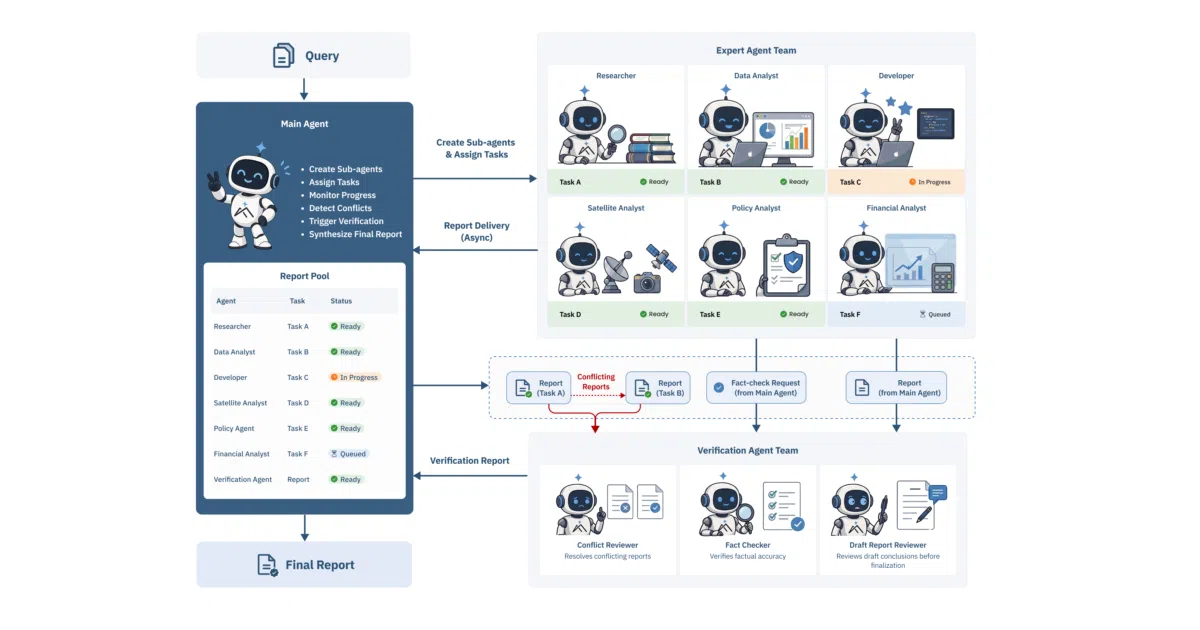
The second workflow, Agent Team, is where the project attempts to differentiate. A coordinator maintains a live task board—visible in the TUI sidebar with pending, active, completed, blocked, and cancelled states—and delegates independent work to parallel sub-agents. Each sub-agent operates within the same sandbox, returns a structured report, and the coordinator synthesizes the result. An optional fast reporter can review evidence before final synthesis. The documentation warns that total simultaneous model calls can approach the product of runner concurrency and team spawn limits, a multiplication that can overwhelm an endpoint during evaluation. This is not decorative parallelism.
Multi-agent orchestration is cataloged extensively in community lists like awesome-agent-orchestration and awesome-ai-agents [8][12], but FrontierAgent’s implementation is tightly coupled to its terminal and sandbox. The task board is not a JSON log; it is a live UI element. The sub-agents are not theoretical actors in a diagram; they are processes that write to the workspace and await coordinator approval. The framework grounds the abstraction in file descriptors.
The Evaluation Layer: Benchmarks as Product
Perhaps the most unusual choice is that FrontierAgent includes its own evaluation suite. The benchmarks directory contains a public harness plus bundled FrontierSearchBench and FrontierChallenge datasets, supporting deterministic artifact collection, concurrency controls, progress inspection, and rerunning individual failures. The runner executes each question in an isolated subprocess, which prevents a poisoned environment from contaminating scores.
The supported benchmark list is extensive: BrowseComp, xbench-DeepResearch, Humanity’s Last Exam (text-only), SuperChem, FrontierScience-Research, FrontierScience-Olympiad, DeepSearchQA, WideSearch, OfficeQA, GDPval, APEX, and OneMillion-Bench. GDPval notably uses deterministic deliverable validation in the open-source harness; the agentic pairwise grader is intentionally excluded, suggesting the authors value reproducible scoring over model-based judging when possible. The harness is designed for resumable multi-run experiments, and the README notes that a minimal smoke run can validate the pipeline before a full evaluation campaign.
By shipping the harness that evaluates its own model, Apodex invites a specific kind of scrutiny. Users can replicate the published Apodex-1.1 numbers—or challenge them—using the same runner. In a landscape where agent benchmarks are often proprietary or ad-hoc, this is a transparency play. It also positions FrontierAgent as infrastructure for researchers who need to compare agent configurations against a common yardstick, not just developers who need a chatbot that can read a PDF.
Position in a Field of 120-Plus Contenders
The agent framework space has become a crowded bazaar. Curated lists track dozens of entries: CAMEL claims to be the first LLM multi-agent framework; CrewAI and LangGraph compete for mindshare; ByteDance’s DeerFlow briefly hit number one on GitHub Trending in February 2026; Orchestral AI pitches itself as a lightweight, type-safe alternative to LangChain and CrewAI [5][12]. Against this backdrop, FrontierAgent’s pitch is architectural completeness rather than minimalism. It does not ask users to compose a chain from scratch; it offers a terminal, a sandbox, a team workflow, and a benchmark runner as a single system.
That completeness comes with weight. The README candidly notes that local SGLang serving is pinned to reviewed NVIDIA driver, CUDA, and SGLang tracks, and a mismatch surfaces late as opaque CUDA or Triton kernel errors during model load. Users must confirm their host NVIDIA driver against a compatibility matrix before choosing an image tag. The project provides helper scripts for macOS, Linux, WSL2, Docker, and managed GPU containers, but the deployment matrix is complex enough to warrant an installation chooser document. For users who prefer not to self-host, Apodex offers an OpenAI-compatible API endpoint, which reduces the runtime to a lightweight TUI and an API key. The base install is intentionally lean; scientific and document packages are optional, and the agent installs only what a task actually needs into a local runtime directory.
Outlook: Runtime as Moat
FrontierAgent’s open-source release reads as a strategic bid to make Apodex’s agent runtime the default substrate for long-horizon, file-based work. By separating the framework, tools, workflows, and terminal layers, the project invites third-party workflows and custom benchmarks. The bundled evaluation harness suggests Apodex wants the repository to become a neutral ground for measuring agentic performance on research tasks, much as LM Evaluation Harness became a standard for static model evaluation.
Whether that ambition succeeds depends on whether the field values sandboxed reproducibility over the convenience of lighter-weight frameworks. The TUI is opinionated, the sandbox is restrictive, and the local GPU setup is finicky. But in a market flooded with agent prototypes that promise autonomy while offering no traceability, FrontierAgent’s insistence on checkpointed sessions, journaled file mutations, and built-in grading looks less like conservatism and more like a long bet on accountability.
Sources
- FrontierAgent | Real estate in the palm of your hand
- The AI Agent Framework Landscape in 2025
- How I Built a Multi-Agent AI System That Changed My ...
- FrontierAgent ONE - App Store
- Orchestral AI: A Framework for Agent ...
- Been building a multi-agent framework in public for 5 ...
- FrontierAgent ONE - Apps on Google Play
- vivy-yi/awesome-agent-orchestration
- What is a ReAct Agent? | IBM
- FrontierAgent ONE 1.8.5 Free Download
- 120+ Agentic AI Tools Mapped Across 11 Categories [2026]
- aloth/awesome-ai-agents: A curated list of ...