ultralytics/ultralytics
One Repo to Detect, Segment, Track, and Pose-Estimate Them All
Ultralytics wants to stop you from stitching together separate repos for every computer vision task by bundling detection, segmentation, tracking, and pose estimation into one YOLO-backed package.
Velocity · 7d
+25
★ / day
Trend
↗accelerating
star history
What it does
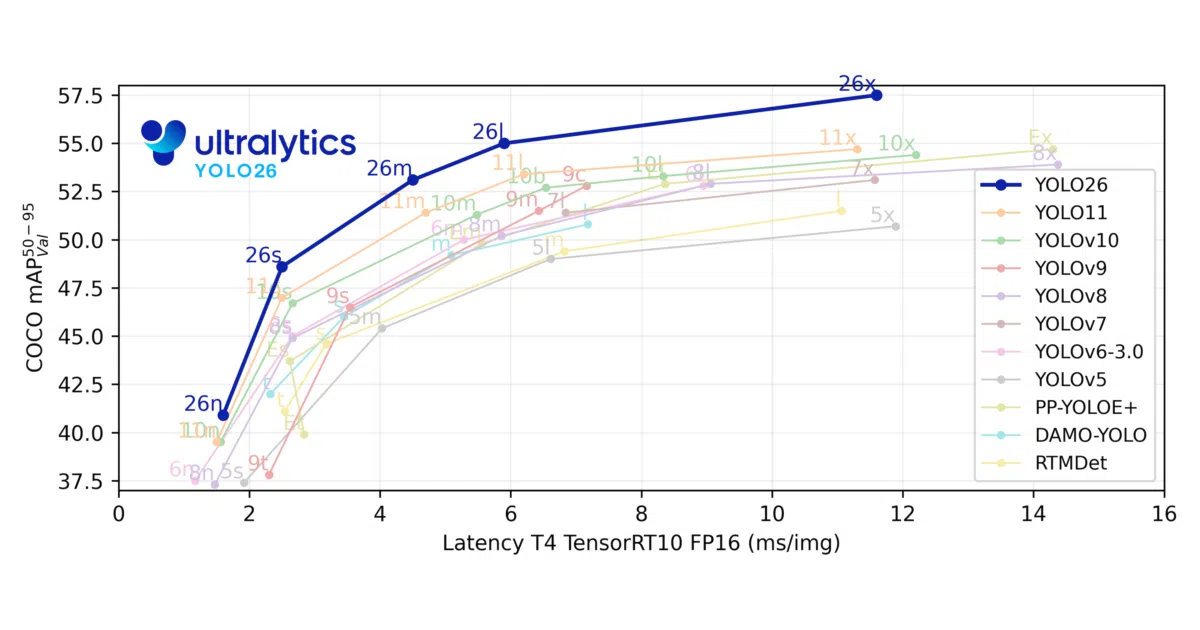
ultralytics is a commercial Python framework that wraps the entire YOLO model lineage—from legacy YOLOv3 up through YOLOv8, YOLO11, and the newer YOLO26—into a single toolchain. It handles object detection, instance and semantic segmentation, image classification, pose estimation, and object tracking behind a shared CLI and Python API. Pretrained weights for standard datasets like COCO, Cityscapes, and ImageNet download automatically the first time you use them.
The interesting bit
The real engineering here is standardization, not novelty. Ultralytics treats training, validation, inference, and export as interchangeable modes of the same model object, so moving from experimentation to an ONNX deployment is mostly a method call rather than a pipeline rewrite.
Key highlights
- Covers six distinct vision tasks (detection, tracking, instance segmentation, semantic segmentation, classification, pose estimation) under one API.
- Weights are hosted on GitHub Releases and fetched on demand; the README publishes self-reported speed and accuracy tables for each variant.
- Supports model export to
ONNXdirectly from the trained model object. - Backward-compatible lineage includes
YOLOv3throughYOLO26, with task-specific variants pretrained on COCO, Cityscapes, or ImageNet.
Caveats
- Commercial use requires an enterprise license from Ultralytics; the open-source package alone is not sufficient for proprietary products.
Verdict Grab this if you need a turnkey, unified vision pipeline and are comfortable living inside the Ultralytics ecosystem. Skip it if you want a lightweight, vendor-neutral research implementation or need to ship commercially without licensing negotiations.
Frequently asked
- What is ultralytics/ultralytics?
- Ultralytics wants to stop you from stitching together separate repos for every computer vision task by bundling detection, segmentation, tracking, and pose estimation into one YOLO-backed package.
- Is ultralytics open source?
- Yes — ultralytics/ultralytics is open source, released under the AGPL-3.0 license.
- What language is ultralytics written in?
- ultralytics/ultralytics is primarily written in Python.
- How popular is ultralytics?
- ultralytics/ultralytics has 62.3k stars on GitHub and is currently accelerating.
- Where can I find ultralytics?
- ultralytics/ultralytics is on GitHub at https://github.com/ultralytics/ultralytics.